Showing posts with label folion. Show all posts

Tuesday, 5 March 2019

Waiter? I say? There are bones in my sausage and my liqueur's on fire.

I mentioned that Sunday is a big day in Carnival. It's oddly timed, following (as Sundays tend to) what for most people is a long, boozy Saturday night, but that's just how it goes at this time of year. Deal with the hangover, get up to the town and partake of the hair of the dog which bit you. You can't miss the parade.

Viana do Bolo is the name of the county, for the want of a better word, in which our village sits, as well as the name of the village itself. It actually comprises around 52 villages of varying sizes, ranging from tiny hamlets of just a few dozen people up to Viana itself. In terms of geographical extent, Viana do Bolo is actually one of the largest counties in Spain, albeit one of the least populated. Many of those villages have their own folion, their own drum beat, and they go visiting each other during the week to drum and enjoy the hospitality, given freely, of the locals. But on the last Sunday, everybody comes to Viana to join the parade.

Each village's folion will come down behind a banner proclaiming from where they've come. From the top of the town they come down through the village, stopping to drum at the main square, and then up to marquees alongside the sports hall for a lunch laid on by the council. Many of them come in bright costumes, and some also put together a carroza, what we'd call a float. That is to condemn the things with a wildly inadequate description, however, because some of these can be absolutely extraordinary. The good people of Quintela can usually be relied upon to deliver here.

This tank, which fired sweets at everybody, is from 2015:


And this, in my view the most spectacular of all, is from last year:


I have no idea how long these things must take to put together but can only imagine they work on them all year. This year's carroza from the Alternativos, a group from Viana itself, was a merry-go-round mounted on the back of a car, revolving as they went. Amazing work, done out of a love of Carnival and for no other reason.

You also get a decent look at the boteiros in the first video, whose crowd control job I wrote about in this entry. As you can see the square is rammed. This is pre-lunch, so there's a roaring trade in vermouth as well as beers and coffee. Many of the bars lose a decent percentage of their glasses during Carnival because people buy their drink, take it outside and never bring it back, moving on to another bar as is the custom here. It's clearly worth the losses, though, because there are more customers about now than at almost any point during the year.

So, to lunch. As I said, those in the parade have grub laid on for them, but everybody else has to make their own arrangements. Many try to cram in one of the few local restaurants. Others have a big feast at a friend's house, gathering in a bodega. For those fortunate enough to have been able to secure tickets, it's the Festa do Androlla, which will be celebrating 50 years in 2020. Androlla is a large, reddish sausage, spiced with paprika. It's a local thing, hugely popular here, but wouldn't be to everybody's taste I think. It contains, you see, large chunks of bone, better to infuse the thing with flavour. It also turns the water in which it's boiled for an hour and a half a deep, bloody red. For the squeamish it isn't. It's typically served with grelos (turnip leaves) and boiled potatoes, but is only one of four courses at the Festa.

So about 1300 people gather in the local sports hall, to enjoy soup, then the Androlla, then lacon, a salty, gammony bacon, then bica, the local cake. Each of these courses is repeated - that is, the dozens of waiters serving the long tables come round with them offering seconds each time. This is supposed to start at 2.30 for a 3pm opening course, but this is Spain after all. The parade will last over two hours and usually runs late anyway. This year's first course was served at almost 4pm. People don't seem to mind too much - there's wine on the table and friends to catch up with.
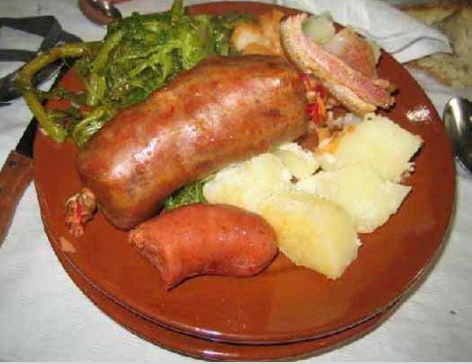
Androlla, grelos, spuds, chorizo and lacon. Twice.
Plus three other courses, obviously. 
Galicians are a gregarious bunch normally, but this is a particularly bad spot if you happen to be suffering a hangover headache. Often the local folion beat will be drummed on the tables, the sound of a thousand spoons cacophonous and deafening. When the waiting staff first stream into the hall with the soup course, whoops and cheers greet them. Often a group of folion or bagpipers will march in to accompany the coffee and liqueurs which round off the thing. It's raucous, informal, friendly and strongly recommended as an experience. 

The sound of this lot beating the tables with their spoons has to be heard to be believed.
This actually represents a slightly trimmed down version of what used to be served, by the way. It sounds ludicrous but I really miss the slow-roasted lamb, served with lettuce in a vinegary dressing, that used to be served as well! You didn't need breakfast or dinner when you had a ticket for the Festa then. Or breakfast the next day.

To help with the feeling of being full fit to burst, a queimada is served last. This is a local fire water, the fire bit being quite literal, which burns brightly in large cauldrons until ready. To say it'd put hairs on your chest would be to understate its power. It's very, very strong stuff but at least sears off the feeling of not being able to move and enables people to file out and head home.

This is pretty much always a cue for me to roll downhill to the house for a siesta, but apparently lots of people head out for more drumming and more drinking after this. I may be used to Carnival by now, this being my 18th I think, but I really don't know how anybody who eats at the Festa is capable of going out and getting back on it afterwards.

Apparently on Monday there's a children's parade and free hot chocolate in the square but I can't honestly say I go out much on the Mondays if I've been to the Festa do Androlla because I just lop around in the house feeling full up and making plans to diet. You have to be ready, after all, for Tuesday, the biggest night of them all.

Thursday, 21 February 2019

And so it begins

I've just been served coffee by a mate of mine, a fairly strapping fellow, dressed in a long, black, sleeveless dress. (He's dressed like that - not me. I'm not that confident even at Carnival). He completed his ensemble with a gold hair clasp and some, to my ignorant eyes at least, expertly applied make-up.

Why this departure from his usually more conventional attire? Because today is compadres, of course, and it marks the first day when the flour throwing kicks in. It's a big day. Special occasion like that, man's got to dress up.

Last night, at midnight, the male Lardeiro was paraded from the top of the town down to the main square, accompanied by folion of course, and hoisted into place above the plaza. Almost immediately, any females present were liberally floured by lads who'd come suitably armed with kilo bags of the white stuff secreted about their person, and those ladies had no recourse to flour back. Today only, this coeliacs' nightmare battle of the sexes is entirely pitched in favour of the men and boys. Tomorrow, a normal free-for-all applies. Next Thursday the female version, the Lardeira, will take her place alongside her mate and the women and girls will have the day to themselves - any male venturing out on comadres accepts the risk of enflourment without comeback.

Brits would call a Lardeiro a Guy, or an effigy. They're the embodiment of Carnival, destined to go up in flames at midnight on Mardi Gras, signalling an end to the seasonal silliness. A sort of Olympic torch in reverse, if you will. Traditionally they were attired in clothes pinched from unsuspecting 'donors', though  I'm told that doesn't happen any more and the clothes are simply worn out, given freely. Their ultimate fate is a spectacular one - they're not just stuffed with rags and newspaper. Their bodies are essentially chicken-wire cages, into which fireworks, bangers and empty aerosol cans are stuffed. The Health and Safety people back in the UK would pass out at how they're made, how they're set aflame and how they're watched as they meet their fate.

You'll have to wait a week, old boy.
She'll be along in due course.

Crossing the square to get to the bar for my coffee, it already looks like it's been snowing. Chaos reigns as shrieking kids run about in fancy dress, boys covering girls' faces in flour, white-faced mums and clean-faced dads watching on in some cases. Today I was able to wear clean, new clothing and walk confidently across the plaza, knowing I wouldn't be targeted. From tomorrow that journey will have to be made at a run, wearing clothing I don't care if I can never don again.

All bets will be off until the Lardeiros burn, and it'll be safe to go out again, it all being over for another year. Apart from the funeral for the giant sardine, of course. More on that at the time.

Monday, 18 February 2019

Yes yes yes - but can it hold a tune?

We're all familiar with the agony of choice when it comes to purchasing our latest trowel head. Who hasn't, doing their routine shop at the ironmonger, stood by the rack wondering which size, which material, which brand? Will the cheapy one do? But the ground's really hard right now, maybe I should go with the professional one at three times the money? I'm sure I don't need to go into detail - you're all trowel-head aficionados here. In Viana it's rather different. When buying a trowel head here, you have to think about Carnival first, and everything else a distant second.

I've mentioned Carnival in passing on here a few times already, and intend to use this year's to write a few entries to go into more detail. For an excellent, rather more articulate outsider's view on Carnival, I recommend Flour on the Skin, a documentary made by a friend of ours a few years back, featuring my missus in front of the camera. Well the Carnival atmosphere in the village is growing already, and the most obvious sign of this is the sound of the folion, the booming beats of the locals' drums and aixadas, rhythms which have become extremely familiar to me.

There are various folion groups, though essentially anybody can play with any group they hook up with. (It's not, of course, quite that cut and dried, and I've learned that something so important to locals is not without its own politics.) They all have two basic ingredients in common, though - large wooden drums, made by locals and both skinned and shoulder-strapped with local animal hides, and aixadas; trowel heads. If you don't fancy lugging a bloody great drum around all evening, or don't have the several hundred Euros each one costs, or simply prefer to play the trowel head, it's the aixada you'll take out with you.

Here's one of ours:

Essential folion kit for the drumless. Note the carry rope made of old
shopping bags - nothing wasted here - and the marks made by hitting
the aixada with the hammer.

As you can imagine, these make a hell of a noise, bringing me back to my original point. It seems that in Viana, if you're my missus at least, you buy your aixada as much for its sound as for any other quality. Exclusively for its sound, in fact, since we have no other use for this item. So it was that last week I found myself at the ironmongers, somewhat incredulously listening to various trowel heads being struck in an effort to determine which had the sweeter note. The ironmonger Jorge, an important figure for the Carnival locally, being heavily involved in organising many of the events associated with it, thought there was absolutely nothing out of the ordinary about this.

I asked him only part-seriously if he sold more trowels for use as percussion than for use in the local farms, and he told me unhesitatingly that there was no doubt this was indeed the case.

I personally prefer to drum rather than go with the trowel. There's something truly visceral about your chest cavity vibrating to the beat of these things, and they can transport the drummers; many of the drum skins are mottled with the blood of the drummers' hands, so carried away do they get with beating them.  When hundreds turn up at once, as they do on the last night of Carnival, Mardi Gras, for the ceremonial burning of the Lardeiros (more on them in a later entry) it can feel like something out of a film. The combination of the huge drum beats, fire, fireworks exploding and flour drifting in the air at the same time is something that truly has to be experienced to be properly appreciated.

Friends who've come here for this, particularly from Britain, have described it in awed terms, leaving wide-eyed and exhausted at the end. Very few people here don't get absolutely animated and excited for it when it comes round. I'll try to give a small flavour of it over the next few entries.