I've always prided myself on a commitment to proper bar etiquette in Britain. I think most people understand the unwritten rules, the bar staff try to apply them when it's not so busy as to be impossible, and there's a general appreciation from your fellow drinkers when you follow said rules. You all know what I mean - don't, when and if asked 'who's next?', call your order ahead of somebody who got there first. I always make a point, if I'm served out of turn, of checking that whoever's ahead of me is already being served or letting them go first. All civilised people agree that this is one of the great features of pub culture and anybody who ignores those rules, boorishly shouting their order as soon as the staff catch their eye, can suffer what in Britain are pretty serious consequences - a hard stare, a disapproving sigh, the shaken heads of the gazumped drinkers. In extreme cases some people may even go as far as politely pointing out to the barman/maid that they were first.
Let me tell you that none of that applies here. Finding it difficult to shake off these old habits, I've found myself standing waiting quietly while others, arriving after me, are served, before eventually the server realises I want a drink and comes to serve me. The reason they don't even realise at first is because I'm not following the unwritten rules of ordering a beer here, which seem to be to be as follows:
Pretty much wherever you are in the bar*, whenever you got there, yell 'pour me a xxx cuando puedas' at somebody behind the bar, and in due course your drink will get to you.
That's it. This 'cuando puedas' is important - 'when you can'. There's no expectation that you'll be served immediately, or in order, but your drink will get to you. I'm already used to the lack of urgency when waiting for your beer, but can't quite bring myself to just yell my order. This has led to some criticism. Criticism that I'm being too polite, both in waiting and in how I then order. A friend here who runs a bar has told me that I should, rather than asking, 'Would you pour me a beer, please?', be shouting, "Pour me a beer, for fuck's sake.' That's how he'd rather I ordered! That way he knows I'm waiting for a beer and that I won't wait longer than is fair. Needless to say I've yet to ask in such a manner.
Though the bar culture is ubiquitous and just as integral to society as British pubs, there are other differences. Nobody drinks pints, of course. The typical order of beer is a caña or a bottle, both around a third to a half-pint. The typical vuelta, the journey round the bars having a drink and a tapa in each, means that many people order a quarter of a pint - a corto. No way you could have a pint in all the bars, even in a place as small as Viana - you'd be paralytic. The one time I ordered a pint here, it was because we'd been cleaning the lake during a drought, and I arrived at the bar so hot, thirsty and dusty that only a pint would do. When it arrived it was clear that the glass had been forgotten in a freezer for some considerable time - so much ice had formed around it that it watered my beer down to the point of undrinkability when it immediately melted. Lesson learned.
No rounds here either, or at least very rarely. This can make paying for your own drink difficult. Not the excuse of a miser - I've always been happy to put my hand in my pocket in the pub - but quite genuinely, I find it hard to buy a drink here. You don't typically pay when you order here, unless it's during the bedlam of carnival or the August fiestas. You pay for everything when you leave. This can lead to people fighting to be the one to pay, often buying the drinks for friends of theirs who happen to be in the bar while they're at it. I've lost count of the number of times I've gone to pay for my drinks, only to be told I'm 'invited' - my beer's been bought for me. You have to get your money down quickly, often insisting at the start, if you want to get drinks for other people. Even this can get you in trouble, though. Not so long ago I spotted a couple in a bar here that I remembered had invited me a few days earlier. I paid for their drinks and when the landlord told them my mate seemed quite genuinely cross that I'd done such a thing, even though it's what everybody does. And it's what he'd done to me before. It's a minefield, I tell you.
Being a small place, the bar owners know all their regulars by name. (I'm not quite at the stage of knowing all the names yet, of which more in another entry soon). You can, if you go out of an evening, essentially guarantee there will be somebody in there you know regardless of which bar you choose, be it the owner or a punter. So while I'm still some way from ordering my caña with a cheery expletive, and don't entirely understand the complexities of when it's OK to 'invite' somebody and when not, I do feel very much at home in the bars here.
*Or indeed outside of it. Just this afternoon I was sitting in one of the bars here and a chap I don't know just yelled 'a white wine here' though the open door as he arrived, sitting down with his mates outside in the confident knowledge that it would come to him.
Thursday, 9 August 2018


Friday, 20 July 2018
Do not adjust your set. There's no point.
I was back in Britain last weekend, accompanying my mother back home after she'd been visiting for a fortnight. Normally we'd spend pretty much every day she's here down at the town's open-air swimming pool, but the weather was not quite as reliable as it usually is during July, so we did have a couple of days where we didn't really get out.
This meant the TV was on for at least a few hours during those two weeks which, the recent World Cup aside, essentially never happens in our house. The reasons for this are twofold; we prefer, during summer particularly, to be out enjoying the lake, the pool or the countryside, and Spanish telly is bad. Really bad. I write that in reasonable confidence that I'm not going to offend any of my Spanish friends because I've never heard anybody disagree with the sentiment here.
Fortunately, there's a button on our remote control which means that any programme which is dubbed into Spanish from any other language (and here that's absolutely all of them - they don't use subtitles for that purpose at all) can be switched to its original format, thereby enabling my dear mother to watch her favourite police procedurals in English. That, though, does not solve the problem of the quality of the broadcasting itself.
That dubbing issue first, though. Now don't get me wrong - the Spanish voice actors who dub these films and TV programmes are excellent. They manage to start and stop the speech at the same time as the original actors and generally do a good job. But there's only a limited number of them, and they try to have the same actor voiced by the same voice actor for everything. While that makes sense, it means that, say, John Turturro sounds like Arnold Schwarzenegger, because it's the same bloke voicing both of them. (I've used two random names, but they serve to illustrate my point.) It jolts you out of a film if the voice is wrong, their mouths aren't moving right, and you're pretty sure you heard that shaven-headed baddie speaking as Howard Wolowitz on The Big Bang Theory only last week. There's also a pretty widespread view here that this has contributed to holding back the learning of English in Spain. Across the border in Portugal, for example, everything is subtitled so people are hearing English spoken on TV and in cinemas all the time. Some of the young shop workers I've spoken to in Chaves have American accents because of the TV, but more of them have a decent level of English than seems to be the case here.
Anyway, I was supposed to be complaining about Spanish telly. Let's take the biggest bugbear of most, the adverts. Pretty much everybody uses the ad break to make a cup of tea or channel hop, right? Or text their mates, or whatever. That's fine if it only lasts three or four minutes but what if, say, an ad break in the middle of a half-hour programme lasted 23 minutes? This is not an exaggeration - it can be well over 20 minutes at a time. They actually put captions up if they're 'only' going for seven minutes, as if it's no time at all. This can also happen at inexplicable moments - you've watched the first hour and fifty minutes of a two-and-a-quarter-hour film uninterrupted by ads, for example, and then you're made to wait 20 minutes for the last chunk while they play ads. How many people are going to stick around in those circumstances?
The different channels from the same groups each also go to ads at the same time no matter where they are in the programme, so you can't escape them (on their network at least) by channel hopping. This leads to ads just popping up on screen, with no ident screen or pause, quite literally mid-sentence. So here's how watching an episode of The Simpsons can play out, for example:
The episode will start with no discernible gap from the previous programme. There's no ident, no announcement, nothing. The show just starts. This can mean that if you've stepped away for even one minute you can come back and be watching a different episode of the same programme without realising it.
For The Simpsons, though, some channels do at least run a shortened version of the intro. As soon as the intro's finished, they head off for adverts. 'Volvemos en 7 minutos', they announce cheerfully. Back in seven minutes. Assuming you're still there when they come back, you may get a few seconds of actual programming. This is not an exaggeration - it can be less than a single sentence and *bop* suddenly you're watching three more minutes of adverts. So you've seen the intro and ten seconds of the episode in just under 14 minutes. Or haven't seen, because you've switched off.
Much worse than the adverts, though, are the tertulias. A tertulia is an informal gathering of people for a discussion, but in this context refers to the chat shows. There are literally dozens of them across all the networks. They're absolutely inescapable on TV here and, let me tell you, dear reader, chatting they ain't. None of my chats with my mates are anything like these. As many as eight people yelling at each other simultaneously about today's political news or, much more likely, celebrity gossip. Relentless, hysterical, asinine and utterly vacuous, this can be two or three hours of the cousin of a Big Brother contestant being 'grilled' by celeb culture 'experts' about their relative, while the same images of said cousin are repeated over and over and over again on one half of the screen. In the unlikely event anybody cares what they're saying, it's impossible to make out (to my English ears at any rate) what's being said because absolutely everybody is hollering at the same time. Horrible and inexplicably ubiquitous - this is, after all, the country that spawned Hola! magazine and myriad competitors.
Then there's the news. Not the sober, neutral, report-the-facts-and-don't-speculate stuff I'm used to on the Beeb. Some of the news bulletins here leave me open-mouthed in astonishment at their speculation or even outright accusations on criminal cases. 'Why did she do it?' ran one headline along the bottom of a screen recently, relating to a murder case that had not yet gone to trial. Absolutely unthinkable in Britain. To finish off any credibility some of the news has here, and to bring me back to the adverts I've already said ruin everything, the news also stops for them midway through. Now I'm not talking about ITN taking a break and coming back in a couple of minutes. I mean the newsreader him/herself stops during the programme and reads out adverts for sofas, or cars, or mobiles. The person you were just hearing tell you about six fatalities in a forest fire is now trying to flog you car insurance on behalf of the news's sponsor. What does that say about the impartiality of the bulletin? What if that channel's Chief Exec was caught with their 'hand in the till'? Or the network received a nice manila envelope stuffed with cash and a two-year contract renewal promise from their ever-generous sponsors provided they not mention the devastating fire at their factory in far-off never-you-mind-where? Do we think we'd hear about that on their news?
So there you go, this blog's first negative entry on life here. It's easy, when there's so much crap on British telly as well, to take it for granted. The BBC in particular though, reminds just how good it is when viewed against Spanish stuff. This does weigh very lightly on the scales, at least; as I've said, this stuff doesn't matter too much in our house because, apart from for live football, we never switch it on. The telly's pretty much superfluous when there's so much to do, so much to appreciate, so much to love here. It's just as well that's the case, though, dear Spaniards, because, with all due respect, TV here is bloody awful.
Thursday, 22 March 2018
Aaah! I cannae feel ma legs...
It's as well humans type with fingers because I can assure you that, had we evolved such that our feet were the more dextrous, and we'd developed computers accordingly, I would not be writing this entry.
Last night I made the all-too-foolish decision to accept the kind invitation of some local lads to play a bit of five-a-side on the village's splendid artificially surfaced and floodlit football pitch. Now I'm always wary of accepting invitations to play football - it can be a bit of a minefield. People can take it too seriously, expecting everybody to play to the same standard, and woe betide the clumsy grey-beard who turns up 'just for fun'. Oh I look the part alright - I've got the necessary footwear, various bits of sports clothing and, of course, several club and national shirts. I look the part right up until the moment I actually have to kick a football, when any impression of competence that may have been adopted based on that appearance will instantly be disavowed.
To use the game's technical terminology, I'm crap. The great levels of enjoyment I get out of playing have never even vaguely been tinged with anything resembling any talent. At secondary school, the games teachers would select a captain of each of the opposing sides, who would then alternate to select their team from the remaining pupils. I was never in the very last group, the lads who couldn't actually kick a ball at all and would rather have been anywhere else, but I was certainly in the group picked shortly before those kids.
I gave the chap who'd been kind enough to invite me to play plenty of warning about this lack of quality. And I mean plenty. But he seemed inexplicably keen that I join in, and I've done basically no exercise for at least a year, so against my better judgement, along I went. Now it's not like in Britain, where courts/pitches etc have to be booked in advance, paid for etc. We turned up, went into the council building to ask for the key to the pitch, switched on the floodlights ourselves and agreed to leave the key in a bar after the football. That's pretty much how things work here - you can always leave something in a bar for somebody to collect in the certain knowledge that a) that person will pass through the bar in due course and b) the bar will know exactly who you mean when you describe who's coming for said item.
So, as I said, we switched on the floodlights and it was then that I realised my mistake in agreeing to play had been two-fold. Despite the kind assurances that the standard would be fine, I could see at least one and possibly more of the lads who play for the village team getting their boots on. Way, way too good for me. And if any one of them was fewer than 15 years younger than me, I'd be surprised.
I was, dear reader, run ragged. I've long got used to watching players breeze past me with contemptible ease, and scoring off my mistakes, but this may well have reached new levels last night. It was five-a-side in name only. I'd say it was effectively five against four, but that would be to understate the enormous drag factor my own 'efforts' had on my side's quality. More like five against net-three-and-a-half.
Through the game I could hear my team-mates ragging each other for missed chances, misplaced passes, failure to save a 100mph shot which burned through the net as it went in, and let's say I've learned enough Gallego to know that they were using the full force of their vocabulary. I, by contrast, was given a very, very easy ride in that respect, and strongly suspect that some of the opponents went easy on me on the rare occasions I had the ball. They probably saw my 'qualities' as we warmed up and pitied me.
For the last half-hour or so I was even more of a spectator than I had been, before mercifully a halt was called, we locked up and then went for a beer. This post-footy ritual at least seems like a universal constant, as one of the greatest things about football after work in London was the opportunity to have a pint and a pub dinner with my brother and mates afterwards. The Spaniards are clearly no different. In any case we had to go to the bar to drop the key off, didn't we? So we pretty much had to go to the bar.
I must report that today my legs feel like they died overnight and rigor mortis has set in. They clearly got something out of my presence, though - perhaps helpless mirth - because I've been invited back. It turns out they play at least three times a week. So that's youth, ability and regular practise - just those three tiny things that separate me from them. Notwithstanding that this is a really good way for me to get to know a few lads that I know by face only, and pick up a bit more Gallego, I must be a glutton for punishment because, to my own slight disbelief, I've agreed to go and play again tonight. I really hope there's beer again after.
Last night I made the all-too-foolish decision to accept the kind invitation of some local lads to play a bit of five-a-side on the village's splendid artificially surfaced and floodlit football pitch. Now I'm always wary of accepting invitations to play football - it can be a bit of a minefield. People can take it too seriously, expecting everybody to play to the same standard, and woe betide the clumsy grey-beard who turns up 'just for fun'. Oh I look the part alright - I've got the necessary footwear, various bits of sports clothing and, of course, several club and national shirts. I look the part right up until the moment I actually have to kick a football, when any impression of competence that may have been adopted based on that appearance will instantly be disavowed.
To use the game's technical terminology, I'm crap. The great levels of enjoyment I get out of playing have never even vaguely been tinged with anything resembling any talent. At secondary school, the games teachers would select a captain of each of the opposing sides, who would then alternate to select their team from the remaining pupils. I was never in the very last group, the lads who couldn't actually kick a ball at all and would rather have been anywhere else, but I was certainly in the group picked shortly before those kids.
I gave the chap who'd been kind enough to invite me to play plenty of warning about this lack of quality. And I mean plenty. But he seemed inexplicably keen that I join in, and I've done basically no exercise for at least a year, so against my better judgement, along I went. Now it's not like in Britain, where courts/pitches etc have to be booked in advance, paid for etc. We turned up, went into the council building to ask for the key to the pitch, switched on the floodlights ourselves and agreed to leave the key in a bar after the football. That's pretty much how things work here - you can always leave something in a bar for somebody to collect in the certain knowledge that a) that person will pass through the bar in due course and b) the bar will know exactly who you mean when you describe who's coming for said item.
So, as I said, we switched on the floodlights and it was then that I realised my mistake in agreeing to play had been two-fold. Despite the kind assurances that the standard would be fine, I could see at least one and possibly more of the lads who play for the village team getting their boots on. Way, way too good for me. And if any one of them was fewer than 15 years younger than me, I'd be surprised.
I was, dear reader, run ragged. I've long got used to watching players breeze past me with contemptible ease, and scoring off my mistakes, but this may well have reached new levels last night. It was five-a-side in name only. I'd say it was effectively five against four, but that would be to understate the enormous drag factor my own 'efforts' had on my side's quality. More like five against net-three-and-a-half.
Through the game I could hear my team-mates ragging each other for missed chances, misplaced passes, failure to save a 100mph shot which burned through the net as it went in, and let's say I've learned enough Gallego to know that they were using the full force of their vocabulary. I, by contrast, was given a very, very easy ride in that respect, and strongly suspect that some of the opponents went easy on me on the rare occasions I had the ball. They probably saw my 'qualities' as we warmed up and pitied me.
For the last half-hour or so I was even more of a spectator than I had been, before mercifully a halt was called, we locked up and then went for a beer. This post-footy ritual at least seems like a universal constant, as one of the greatest things about football after work in London was the opportunity to have a pint and a pub dinner with my brother and mates afterwards. The Spaniards are clearly no different. In any case we had to go to the bar to drop the key off, didn't we? So we pretty much had to go to the bar.
I must report that today my legs feel like they died overnight and rigor mortis has set in. They clearly got something out of my presence, though - perhaps helpless mirth - because I've been invited back. It turns out they play at least three times a week. So that's youth, ability and regular practise - just those three tiny things that separate me from them. Notwithstanding that this is a really good way for me to get to know a few lads that I know by face only, and pick up a bit more Gallego, I must be a glutton for punishment because, to my own slight disbelief, I've agreed to go and play again tonight. I really hope there's beer again after.
Wednesday, 24 January 2018
Drums, please
I've probably mentioned the frenzy of flour throwing that happens around here in the build-up to Mardi Gras, and will do so again shortly. It's all part of the Latin world's celebration of Carnival which closes as Lent begins, and it's kind of started already.
A couple of weekends back, various groups were invited to Viana from all over Spain to participate in La Mascarada, a parade of fulions (the locals' various drum beats) and masked costumery of all kinds. It's kind of a cultural exchange, showcasing in another town what you all do yourselves during Carnival. The people who were good enough to come and visit all did so out of a love of Carnival and a desire to showcase their own celebrations, and for no financial rewards at all. It was a clear demonstration of how important these annual rituals are that they'd come so far for just a couple of days, some of them sleeping in the local sports hall, to do this.
I've now seen so many of these parades that none of what happens comes as even a vague surprise, but I do wonder how this must look to anybody who's never seen it. The images here, used with the kind permission of local photographer J Luis Ortiz, give a much better impression than anything I could write as to what goes on. As for the sound of the huge drums being beaten to the various Galician villages' own rhythms, you'll have to trust me that you can quite literally feel your entire chest cavity vibrating to the beat. More on those in another entry later - the drums are hugely important to the locals and deserving of their own entry and images.
The first sign that the parade has started (other than the approaching thunder of the drumming, of course) is the sound of bells. Then these guys come charging down the road, clearing the path for the coming parade.
 |
| Boteiros - crowd control Carnival style. Photo: J Luis Ortiz. |
The headwear these Boteiros sport are all, of course, hand-made, and can weigh anything up to 20kg. Many of them wear neck braces under the masks to help support the weight, but I've seen just how tiring it is running up and down and pole vaulting with their sticks with that kind of weight on their heads. I'd be surprised if they don't all finish each Carnival a couple of inches shorter.
Once the route's been cleared, the Boteiros shuttling back and forth keeping people back, down come the various groups. If they're from this part of Galicia the group will almost certainly include drummers beating the fulion, but those from elsewhere come in all kinds of finery, from Guadalajaran devils wearing real cows' horns, potato chunks cut into bizarre teeth shapes jutting from their mouths, to whatever this is;
 |
| "Where are you taking this... thing?" One for Star Wars fans there. Photo: J Luis Ortiz. |
I couldn't see where these horsemen and women came from - each group carries a small sign naming their home town - but they stopped in the main square and challenged each other to a sort of saddled poetry-off. I'd love to tell you what they said but it was all in Gallego, which I still sadly lack as a language, and it was in any case all but impossible to hear them over the cacophony of cow bells, drums and inflated animal bladders being used for percussion.
 |
| "Speak up! I can't hear a thing..." Photo: J Luis Ortiz. |
The arrival of Viana do Bolo's own 'Alternativo' fulion group signals the end of the parade, and it breaks up into various impromptu drinking and drumming sessions. Everybody who's been part of it heads up to the top of the town, where food and drink has been laid on for them in the sports hall. Later, after a couple of cold drinks in town overnight - it was a Saturday after all - they go and do the same thing again in another village a few miles away, before heading home for their own Carnival celebrations. As for Viana, we can all expect to have our faces covered in flour pretty much as soon as February starts - much more on that in a later entry.
(Incidentally, as regularly as I've attended this sort of thing now, I was still told by one of the local kids that I 'looked really English' after the parade simply because I was wearing a long, black coat and carrying an umbrella. It was bloody raining!)
 |
| Yeah those aren't balloons. The were once inside a cow and they make a lot of noise when they're banged together. Photo: J Luis Ortiz. |
 |
| See? I told you it was raining. I was hardly the only person carrying a brolly. Photo: J Luis Ortiz. |
Thursday, 7 December 2017
Salt water gets in my eyes
In the early hours of Wednesday Dec 6th my partner’s mum Julia, known by literally everybody in the village and many more in Valladolid, Menorca and beyond, was taken from us at the end of a most valiant battle with a litany of diseases, principally among them cancer. I don’t really know where to begin here because it’s difficult to do her courage justice if you hadn’t seen for yourself just how many medicines she had to take, how many times she had to self-inject insulin, how long she spent connected to oxygen machines whether at home or out and about.
This is not how I’m going to remember her. When I first met her, on holiday in Menorca (an island on which she worked seven days a week for entire seasons without a break, and came to love enormously), I was just some guiri, some football-shirt-wearing Englishman with barely a word of her language who somehow seemed to be going out with her eldest daughter. From the first moment, though, she showed me nothing but kindness and acceptance, the genuineness of her warmth and laughter quickly becoming part of the fabric of my own life as I begun to learn about and appreciate Spanish life and culture.
Her laugh was loud, throaty and infectious. Many years ago it was heard by pretty much the entire staff and clientele of a major department store in Valladolid when, waiting for my partner to emerge from the changing rooms and struggling with the early stages of picking up the language, I inadvertently told her I have two ‘turnips’ - I don’t need to tell you what that’s a euphemism for here. My missus heard her laughing from inside the changing rooms and certainly heard her when she came out and Julia delightedly yelled what I’d said across the whole floor, announcing how lucky her daughter was.
Years later, in my own kitchen in London, while my Spanish had improved, it still wasn’t at the point where there were never gaps or misunderstandings. We were talking about food, shellfish in particular, and needed a mutual understanding of ‘crayfish’. Frustrated at my ignorance of the word, she started imitating one. Arms bent, fingers opening and closing for claws, she did a left-right-left sideways dance that looked like something out of SpongeBob and did little for my comprehension of cangrejo de rio but was hugely entertaining.
She did, of course, help me hugely over the time I knew her, our comversations bringing my Spanish on and always punctuated by that laugh. That laugh - like a witch who’s just been told an absolutely filthy joke - has consistently been one of the first things people have mentioned when they’ve called her daughters to console them. It remained in place despite all her health battles - I can’t recall hearing her complain about the long list of troubles her own body was giving her, but I can remember that laugh, readily.
Her absence in our house is going to be huge, the silence where she should be profound. We’ve got so used to the low hissssss-thump of her oxygen machine, so used to her yelling abuse at the ‘bobos’ contesting the Spanish version of Wheel of Fortune. She was always quick to get the answer, whether it was correct or not being another matter. (Though she usually was). Her strength of conviction in her right-ness, if there’s such a word, could also lead to hearing that laugh again. ‘No, no, no, no and no, I tell you,” she once said when discussing a place name with one of her daughters. “Or probably yes.” Cue laughter...
Even two days before she died, the TV above her hospital bed was getting a good talking to when Pasapalabra came on, an indication we’d alwys taken to mean she was feeling fairly well on any given day.
It was not to be, though. They’ll have to muddle through the shows without her ‘advice’ now. Doted on by her daughters, who were with her the entire time during her last spell in hospital, and survived by two distraught brothers, she wouldn’t like the tears we’re all shedding for her at the moment, but they’re an indication of the huge love everybody had, and will have, for her.
Those tears will of course, in time, give way to sweet recollections. Outside her hospital window, ten floors up, storks circled gracefully over a foggy Valladolid as we passed her last hours with her, just as they do in the skies above her beloved Viana. That’s how I’ll come to remember her in time, I think - soaring, confident, admirable. Descansa en paz, Julita, reina. Adios y gracias.
This is not how I’m going to remember her. When I first met her, on holiday in Menorca (an island on which she worked seven days a week for entire seasons without a break, and came to love enormously), I was just some guiri, some football-shirt-wearing Englishman with barely a word of her language who somehow seemed to be going out with her eldest daughter. From the first moment, though, she showed me nothing but kindness and acceptance, the genuineness of her warmth and laughter quickly becoming part of the fabric of my own life as I begun to learn about and appreciate Spanish life and culture.
Her laugh was loud, throaty and infectious. Many years ago it was heard by pretty much the entire staff and clientele of a major department store in Valladolid when, waiting for my partner to emerge from the changing rooms and struggling with the early stages of picking up the language, I inadvertently told her I have two ‘turnips’ - I don’t need to tell you what that’s a euphemism for here. My missus heard her laughing from inside the changing rooms and certainly heard her when she came out and Julia delightedly yelled what I’d said across the whole floor, announcing how lucky her daughter was.
Years later, in my own kitchen in London, while my Spanish had improved, it still wasn’t at the point where there were never gaps or misunderstandings. We were talking about food, shellfish in particular, and needed a mutual understanding of ‘crayfish’. Frustrated at my ignorance of the word, she started imitating one. Arms bent, fingers opening and closing for claws, she did a left-right-left sideways dance that looked like something out of SpongeBob and did little for my comprehension of cangrejo de rio but was hugely entertaining.
She did, of course, help me hugely over the time I knew her, our comversations bringing my Spanish on and always punctuated by that laugh. That laugh - like a witch who’s just been told an absolutely filthy joke - has consistently been one of the first things people have mentioned when they’ve called her daughters to console them. It remained in place despite all her health battles - I can’t recall hearing her complain about the long list of troubles her own body was giving her, but I can remember that laugh, readily.
Her absence in our house is going to be huge, the silence where she should be profound. We’ve got so used to the low hissssss-thump of her oxygen machine, so used to her yelling abuse at the ‘bobos’ contesting the Spanish version of Wheel of Fortune. She was always quick to get the answer, whether it was correct or not being another matter. (Though she usually was). Her strength of conviction in her right-ness, if there’s such a word, could also lead to hearing that laugh again. ‘No, no, no, no and no, I tell you,” she once said when discussing a place name with one of her daughters. “Or probably yes.” Cue laughter...
Even two days before she died, the TV above her hospital bed was getting a good talking to when Pasapalabra came on, an indication we’d alwys taken to mean she was feeling fairly well on any given day.
It was not to be, though. They’ll have to muddle through the shows without her ‘advice’ now. Doted on by her daughters, who were with her the entire time during her last spell in hospital, and survived by two distraught brothers, she wouldn’t like the tears we’re all shedding for her at the moment, but they’re an indication of the huge love everybody had, and will have, for her.
Those tears will of course, in time, give way to sweet recollections. Outside her hospital window, ten floors up, storks circled gracefully over a foggy Valladolid as we passed her last hours with her, just as they do in the skies above her beloved Viana. That’s how I’ll come to remember her in time, I think - soaring, confident, admirable. Descansa en paz, Julita, reina. Adios y gracias.
 |
| Julia Hernández García 1951–2017 |
Tuesday, 24 October 2017
The Pied Pipers of Punxeiro
I was warned, when I bought our tickets for the Festa da Vendima at the ironmongers from where they're sold, "Cuidado, eh." Be careful - an Ingles at Punxeiro's annual harvest festival? Did I know what I was letting myself in for?
This is pretty standard ribbing, of course, but later, when another friend told me that he no longer goes because it's a little bit full on, I confess I did wonder what was coming. Punxeiro is a very small village higher up the mountains. So small that, much like Castiñeira of an earlier entry, no shop or even bar is in evidence. (It's possible I simply missed them in the revelry described below, of course. But I don't think so.)
Now my memory of harvest festivals doesn't go beyond those dull affairs at school where you had to bring in some non-perishable food item, which would be gathered together in some kind of display at the front of assembly, later to be distributed to some undefined and, to my childish brain mysterious, deserving and needy recipients. This was not that.
You're picked up, if you're going from Viana, by a free bus which drives you the twenty minutes or so uphill to the starting point, at which your ticket is exchanged for a neck tie and a small ceramic cup;

These are yours to keep, and you can immediately discern the regulars at this affair, as they quickly tie the two together through the cup handle and then round their necks, so they're wearing the cup as a sort of pendant. Only a stupid English person would put the neck tie on but keep the cup in hand all night because he's too worried he won't tie it well enough and it'll drop to the floor, breaking and curtailing the evening's drinking. (I'd argue though that the above photo is triumphant validation of my approach, but all the other cups seem to have reached people's homes undamaged anyway.)
'Never mind the cup. How are you supposed to spend the evening drinking in a village with no bars?' I'm glad you asked. A lack of bars has not stopped the generous inhabitants of Punxeiro putting on a hell of a party by opening their bodegas. The bodega is a typical feature of many Spanish homes. A sort of designated entertaining space, often below the house but occasionally on the ground floor, they usually include a large dining table, storage for wine and space to cure meats, and often feature a fireplace to do a bit of open-flame cooking.
How do you find them in the dark? You follow the band. Known as charangas, these are usually groups of locals who'll act as guides for the evening. They strike up a tune and lead you, behind a sort of wheel cart light show, to the next bodega to open. People, filling the narrow streets of the village so thickly that it can become impassable if you happen to want to go against the tide, follow happily behind it and wait for the doors to open.
When they do, out comes apparently unlimited supplies of wine and tapas of myriad variety. The locals work their way through the throng with large jugs of red in one hand, white in the other, followed by tray after tray of tapas of every kind, both savoury and sweet. It comes in no particular order so you find yourself eating chorizo followed by chocolate brownie followed by favada followed by rice pudding, and so on in little mouthfuls. They move through the densely packed crowds, hundreds of arms reaching over them, round them, across them to pick at the trays like so many octopuses (octopi? octopodes?) which have somehow managed to live past market day. It seems impossible that there would be enough for so many people.
It now becomes clear, though, why I was warned when I bought the tickets. The little cups hanging from everybody's neck ties are refilled constantly, so you have no idea how much you've drunk. The wine, to be charitable, isn't the finest stuff - it's all home-made and very young. But what it lacks in quality, they make up for with generosity. The wine, and the food, just keep coming.
Eventually the bodega runs dry of both, the band strikes up and moves on to the next one, followed by the increasingly 'cheerful' throng, and the next bodega repeats the process. And so on. Locals, clearly identifiable in bright yellow T-shirts, run hither and thither keeping things as organised as they ever can be at such things in Spain. The ironmonger who sold me the tickets must have run past me at least three times himself. I think there were about half a dozen stops during the whole thing, but can't clearly remember, as this mobile shindig made its way round the village towards the after-party at the end.
This comprises two large stages set up in a clearing after the last bodega. It's a considerably larger affair than the three-in-a-van party at Castiñeiro. The first band Los Player's, twelve artistes dressed like a cult of Butlins red-coat worshipers, boasted a giant, dazzling light show to go with their wildly superfluous apostrophe. We sat and watched them for half an hour or so, and then headed home. Way, way too many people for the bus, so we walked down an unlit track, through pitch-black countryside, only mobile phone lights, drunks and mysterious noises from left and right to accompany us. At one point a fellow shambled out of the dark going uphill, against all logic, looking for all the world like a zombie as he appeared in our little pool of light for just a few moments, lumbering past us towards a piss-up he was extremely late for with no light whatsoever to show him the way.
Good people of Punxeiro, I'll be back next year - it was a blast. I'll bring a few beers, though, as do some of the more experienced visitors, because it's entirely absent. Oh and I'l be tying that cup around my neck in the approved manner so I don't look like quite such a bewildered newbie.
This is pretty standard ribbing, of course, but later, when another friend told me that he no longer goes because it's a little bit full on, I confess I did wonder what was coming. Punxeiro is a very small village higher up the mountains. So small that, much like Castiñeira of an earlier entry, no shop or even bar is in evidence. (It's possible I simply missed them in the revelry described below, of course. But I don't think so.)
Now my memory of harvest festivals doesn't go beyond those dull affairs at school where you had to bring in some non-perishable food item, which would be gathered together in some kind of display at the front of assembly, later to be distributed to some undefined and, to my childish brain mysterious, deserving and needy recipients. This was not that.
You're picked up, if you're going from Viana, by a free bus which drives you the twenty minutes or so uphill to the starting point, at which your ticket is exchanged for a neck tie and a small ceramic cup;

'Never mind the cup. How are you supposed to spend the evening drinking in a village with no bars?' I'm glad you asked. A lack of bars has not stopped the generous inhabitants of Punxeiro putting on a hell of a party by opening their bodegas. The bodega is a typical feature of many Spanish homes. A sort of designated entertaining space, often below the house but occasionally on the ground floor, they usually include a large dining table, storage for wine and space to cure meats, and often feature a fireplace to do a bit of open-flame cooking.
How do you find them in the dark? You follow the band. Known as charangas, these are usually groups of locals who'll act as guides for the evening. They strike up a tune and lead you, behind a sort of wheel cart light show, to the next bodega to open. People, filling the narrow streets of the village so thickly that it can become impassable if you happen to want to go against the tide, follow happily behind it and wait for the doors to open.
When they do, out comes apparently unlimited supplies of wine and tapas of myriad variety. The locals work their way through the throng with large jugs of red in one hand, white in the other, followed by tray after tray of tapas of every kind, both savoury and sweet. It comes in no particular order so you find yourself eating chorizo followed by chocolate brownie followed by favada followed by rice pudding, and so on in little mouthfuls. They move through the densely packed crowds, hundreds of arms reaching over them, round them, across them to pick at the trays like so many octopuses (octopi? octopodes?) which have somehow managed to live past market day. It seems impossible that there would be enough for so many people.
It now becomes clear, though, why I was warned when I bought the tickets. The little cups hanging from everybody's neck ties are refilled constantly, so you have no idea how much you've drunk. The wine, to be charitable, isn't the finest stuff - it's all home-made and very young. But what it lacks in quality, they make up for with generosity. The wine, and the food, just keep coming.
Eventually the bodega runs dry of both, the band strikes up and moves on to the next one, followed by the increasingly 'cheerful' throng, and the next bodega repeats the process. And so on. Locals, clearly identifiable in bright yellow T-shirts, run hither and thither keeping things as organised as they ever can be at such things in Spain. The ironmonger who sold me the tickets must have run past me at least three times himself. I think there were about half a dozen stops during the whole thing, but can't clearly remember, as this mobile shindig made its way round the village towards the after-party at the end.
This comprises two large stages set up in a clearing after the last bodega. It's a considerably larger affair than the three-in-a-van party at Castiñeiro. The first band Los Player's, twelve artistes dressed like a cult of Butlins red-coat worshipers, boasted a giant, dazzling light show to go with their wildly superfluous apostrophe. We sat and watched them for half an hour or so, and then headed home. Way, way too many people for the bus, so we walked down an unlit track, through pitch-black countryside, only mobile phone lights, drunks and mysterious noises from left and right to accompany us. At one point a fellow shambled out of the dark going uphill, against all logic, looking for all the world like a zombie as he appeared in our little pool of light for just a few moments, lumbering past us towards a piss-up he was extremely late for with no light whatsoever to show him the way.
Good people of Punxeiro, I'll be back next year - it was a blast. I'll bring a few beers, though, as do some of the more experienced visitors, because it's entirely absent. Oh and I'l be tying that cup around my neck in the approved manner so I don't look like quite such a bewildered newbie.
Friday, 20 October 2017
After the flames
We''ve just driven back, this time in daylight, through the area that was ablaze in the early hours of Monday morning, pictured in my previous entry. We, and our village, have been fortunate - the flames stopped a couple of miles short of us. Others, including friends of ours, have not been so lucky, losing crops which represent their livelihoods to the fire.
The mountainsides are charred black and smell, still, of smoke. It's an appalling sight and a heartbreaking one, to see what should be green and verdant beauty reduced to ashes as it is. The national news screens have been filled with images of burning forests and farms, Galicians weeping at having lost everything to the flames. Four people are dead. Portugal has had it even worse, with almost 40 people killed there. It's been a very difficult week and, understandably, despair is giving way to anger. Anger at the people who started fires deliberately - there have been arrests already. Anger too at what's perceived to be a passive, reactive rather than preventative fire policy from the Galician government. Certainly it's true that, driving back home today, freshly cut fire breaks were evident in the forests which cover the landscape - too late when the flames have already been and gone in so many places. It seems also that more than 900 of the firemen who stand ready during the long, dry summer months were stood down in very early October, despite the clear and ongoing threat.
It's simply too much of a coincidence for me that, with desperately needed rain finally coming on Monday night, more than 100 fires were active in Galicia that same day. Yes, it's entirely possible that it was the consequence of so little rain for so long, but 105 separate fires just hours before that rain finally fell, all over the region? I know nature can appear cruel but it's quite clear here that people, always capable of infinitely more cruelty, calculated as it is, have fanned nature's own flames here.
The areas around our town which burned in the fires of two years ago are now patchworks of green and black. Bushes and grasses are hiding the black scars of previous fires. Plant life recovers quickly, of course, and those areas will, if they're allowed to, recover eventually. The trees, though - they're gone. It's going to take a very long time for them to come back properly - too long for many of the residents here to live to see it.
I sincerely hope that anybody who is proven to have started any of these fires is given a very long time to think on what they've done.
The mountainsides are charred black and smell, still, of smoke. It's an appalling sight and a heartbreaking one, to see what should be green and verdant beauty reduced to ashes as it is. The national news screens have been filled with images of burning forests and farms, Galicians weeping at having lost everything to the flames. Four people are dead. Portugal has had it even worse, with almost 40 people killed there. It's been a very difficult week and, understandably, despair is giving way to anger. Anger at the people who started fires deliberately - there have been arrests already. Anger too at what's perceived to be a passive, reactive rather than preventative fire policy from the Galician government. Certainly it's true that, driving back home today, freshly cut fire breaks were evident in the forests which cover the landscape - too late when the flames have already been and gone in so many places. It seems also that more than 900 of the firemen who stand ready during the long, dry summer months were stood down in very early October, despite the clear and ongoing threat.
It's simply too much of a coincidence for me that, with desperately needed rain finally coming on Monday night, more than 100 fires were active in Galicia that same day. Yes, it's entirely possible that it was the consequence of so little rain for so long, but 105 separate fires just hours before that rain finally fell, all over the region? I know nature can appear cruel but it's quite clear here that people, always capable of infinitely more cruelty, calculated as it is, have fanned nature's own flames here.
The areas around our town which burned in the fires of two years ago are now patchworks of green and black. Bushes and grasses are hiding the black scars of previous fires. Plant life recovers quickly, of course, and those areas will, if they're allowed to, recover eventually. The trees, though - they're gone. It's going to take a very long time for them to come back properly - too long for many of the residents here to live to see it.
I sincerely hope that anybody who is proven to have started any of these fires is given a very long time to think on what they've done.
Monday, 16 October 2017
Burning pain
It’s a deeply troubling feeling to wake up in the middle of the night to the smell of smoke. That’s what happened in the early hours of this morning, though, in our house. The unmistakable smell of burning filled the house, and for a few moments we wondered if our home was on fire.
It turned out, though, that it was Galicia itself which is burning. The whole village, dark as it was, was wreathed in a smoky haze. Two minutes outside and our hair and clothes stank of smoke. There are already forest fires all over the area - the city of Vigo in particular being aflame in spectacular and horrifying manner, but the one we passed through this morning is the closest yet to our home.

We had to get up at 5am anyway, to make the journey to Valladolid. It’s just as well we did, because the first part of the drive we were greeted by these scenes, and not more than half an hour after we passed, the road had to be closed as the flames reached the very edge of the road itself.


One really troubling thing about these fires is that they’re so widely agreed to have been set, at least in some cases, deliberately. Of course the two-year drought that Galicia is currently suffering has a lot to do with it, but the region’s government has openly stated that their ‘principal hypothesis’ is that the fires are man-made, the starting sites chosen carefully. The reasons for this are so clouded in gossip and speculation that it’s difficult to see clearly what the truth may be, but certainly a similar case in Italy resulted in the arrest of six firefighters recently. It was so widely believed to be the case anyway, before any such comment was made official, that this is one of those things that’s become fact in the retelling, whether it’s correct or not. I’ve certainly heard it said by plenty of people in the last few months anyway.
The map of where the fires are in Galicia right now shows the scale of the task facing a firefighting force depleted, according to members of that same force, by cuts and stretched by the widespread nature of the problem. There simply aren’t enough men, aren’t enough fire trucks, aren’t enough helicopters and isn’t enough water to fight them effectively. (We’ve just heard, for example, that the effort to combat ‘our’ fire has been opened to anybody who feels able to give them a hand. Can you imagine that in Britain?)
Galicia, usually so green and beautiful, is becoming a charred ruin of its former self. There is, after months without a drop of it, rain forecast for tonight and the next few days. It’s come too late to help many people already. We can only hope it comes soon enough to help Viana.
Saturday, 9 September 2017
The long way round
These past couple of days we’ve travelled across a significant chunk of northern Spain, from our house in Galicia to Barcelona, by car - my partner's little Mini soft-top. Splitting the journey into two parts, it meant I saw parts of Spain that I’ve never been anywhere near. Most of those places we saw from the car, of course, but breaking up the journey as we did, we were also able to stop off and see some spots closer up - a proper road trip if you like, albeit only a Mini one. (See what I did there?)
Heading across from north-east to north west, though it’s only a very slightly diagonal route across the country, it’s still something like a nine-hour drive if you do it in one go.
So we had a bit of a look to see where might be interesting to stop. Sometimes you get what you expected, and sometimes you really don’t. First stop was a place called Sahagún, a little pueblo in Castilla y Leon, the flat centre of Spain. A pretty place, it features Roman architecture but is dominated by a 13th-century monastery, and being on one of the routes of the Camino de Santiago, it’s full of walkers stopping off to take a break and get something to eat.
 |
| How the route looks on Google maps. |
Coming into the town, the first thing we saw was a bonfire inside the walls of the cemetery. An odd sight, frankly, and it did lead to some fairly morbid thoughts about cremation corner cutting, though perhaps that reflects more on me than anything else. We stopped at a café right by the monastery, which seemed to have its own cat sanctuary attached. Beautiful, no doubt hugely valuable leopard-print cats lazed inside a caged-off, outdoor section cleverly sited right next to the establishment’s terrace. The cats worked their magic and we sat down for a drink. We’d have stayed longer than we did but two things put us off a bit - one was that the bar owner clearly regarded his place’s status as a designated Camino stop as an opportunity to charge Madrid-type tourist prices for his drinks. The other was that he’d apparently borrowed his cloth from the bar at the foot of hell’s stairway - right by the gift shop - because he wiped the tables with it and the stench it left behind, worsening as the sun baked it into the tables’ very essence, was genuinely unbearable. Get some bleach, man. Bleach! Off we went.
Once down from Galicia’s mountains and getting into the Spanish plain, birds of prey can be seen circling at least every kilometre or so, and often more frequently than that. They also sit imperiously on the top of roadside fence posts, beautiful and statuesque as you zip past them. They’re often the most eye-catching thing in sight; you’d be forgiven, in parts of the long schlep across the flat plain of Spain, for thinking you were in a desert crossing the US. Long, arrow-straight roads bisect often quite arid landscapes. Settlements are few and they’re separated by long distances. I even saw a couple of these things during this part of the journey:

But there isn’t too much to report on this section of the drive, to be honest.
Moving into La Rioja, almost immediately the hand of humanity begins to dominate the landscape and two crops prevail; sunflowers and the famous grape named for the region. For me the sunflowers were more interesting. Past their bloom, they've been left to wilt in the sun for their oil, and turning a monkish grey-black as their heads sink as if in supplication, they make for an almost devotional sight. These are not the 8ft giants you might think; rather they’re mainly around two or three feet tall. Odd, randomly spaced, taller individuals stand out, though, making the scene look like adults dotted among their more numerous and younger charges, as if in protection of them.
We stopped at Logroño for lunch. Now the only thing I knew about Logroño beforehand was that their football team spent the nineties in the top flight in Spain and then went bust. But, assured by a friend who visits there frequently that it was a good place to eat, and being essentially on our route anyway, that’s where we headed. Initial impressions were fairly unimpressive but once parked up and into the old town, the recommendation held true. We filled ourselves with excellent tapas and could have chosen from any one of dozens of ‘proper’ tapas places, with people having a bit of lunch standing up outside the bars, a quarter of a pint or a little Rioja to wash it down. The real, Spanish way of doing tapas. Heading back to the car, a sign of the country’s still significant political divide. A stone in the wall of a church inscribed with a paean to the glory of the Caudillo, the self-aggrandising General Franco who so named himself, splashed with black paint evidently thrown at it from below. Evidence of the fury which he still evokes on the opposite side of Spain’s political spectrum, and of the ongoing respect in which he’s still held by some quarters of the country’s right wing - in Germany, for example, any inscription of that type would most certainly have been removed long ago.
After La Rioja comes Zaragoza, less interesting apart from the mountains which seem to track your progress from a distance. Never seeming any nearer or further away, I kept thinking their presence felt like those pantomime villains who, disguised as some part of the landscape, stop moving just before the hero turns round to try to catch them out. Moorish architecture, or buildings at least inspired by it, dot the landscape here. The region’s capital, Zaragoza, was another stopping point for us - a chance to stretch our legs and see what this city, well-known by name if not by acquaintance for us at least, had to offer. That Moorish influence was most clearly evident in the Palacio de la Alaferia, a sort of less famous and plainer cousin to the Alhambra. Though splendid and interesting, we fairly skipped round it because the adjacent barrio in which we’d parked the car did not do justice to its imposing neighbour. It was a bit sketchy, frankly, so we moved on again.
 |
| The Patio de Santa Isabel at the palace. Pic in public domain. |
Next was Huesca - scrubby and bland, to be honest. Even those predatory birds which so frequently marked our progress earlier are absent here. Only fields of maize or stunted bushes for company as far as the eye could see either side of the road, we crossed the Greenwich Meridian, marked quite clearly with a large arch over the road in the middle of bloody nowhere, not long after the Sat Nav had told us rather blandly to ’stay on the E-30 for next 239km’. OK, we’ll do just that and… wait, what? 239km? Madre mia! This reminded me of the sign saying ‘Barcelona - 502km’ we’d seen the day before. I realise that there are far, far larger countries you can drive across, but I just never saw these kinds of numbers in Britain. And we were still a decent drive from Barcelona even at this point.
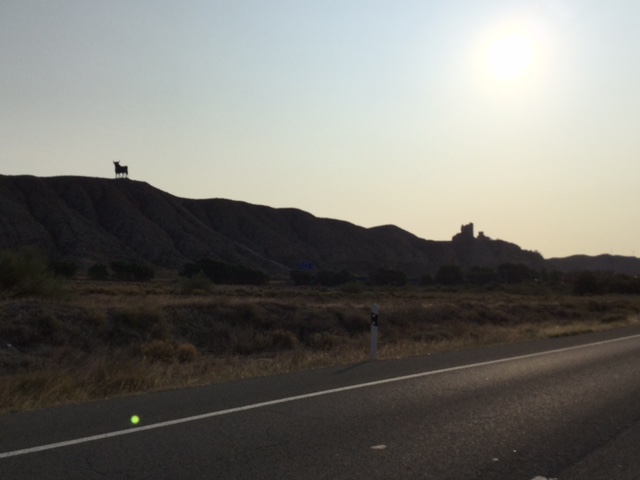 |
| Bull silhouette and ruined castle on the road through Huesca. |
Finally, into Catalunya. An impending referendum on independence may yet mean that, some day in the future, we’d be entering another country making this same trip. Certainly the road signs’ language changes immediately anyway. Traffic thickens as we near Barcelona itself, and after hundreds of kilometres of pretty straightforward instructions from the Sat Nav (don’t get me started on ‘her’ pronunciations of all the place and road names, which had my missus laughing openly more than once), we really did need her direction to find our way around the famous city.
With an hour to kill before we needed to put the car on the ferry, we had time to have a quick walk around the Barrio Gótico and Las Ramblas and buy some snacks for the final leg of the journey; the ferry crossing to Mahón. The Ramblas were just as I remember - crowded, with people from all over the place speaking numerous languages, over-priced craft stalls etc. The recent attacks seem to have failed to keep people away, just as they did in Paris, London, Berlin and pretty much anywhere else I can think of. There was, though, as we got back to the car to await our call to board, an extensive police presence at the port itself, holding people up who’d come in from Algeria as each and every car was checked thoroughly. I don’t know if this was the case before the attacks, or if it represents a sort of Islamophobia that is just what the terrorists are looking for, but it certainly looked to my eyes to be a marked contrast to the ‘business as usual’ look of the Ramblas.
I’m typing this on board, though I’ll have to wait to upload it. The Med is, as it always seems to be, calm and blue. The crossing will take seven hours, and we’ll be in Menorca, where we’ll spend the next couple of weeks hopefully catching the last of this year’s sun. Then we’ll have to work out where to stop while doing the same journey back across Spain, this time east to west.
Sunday, 3 September 2017
Sinking the unthinkable
For some time now we've been the fortunate owners of a couple of canoes, generously gifted to us by my partner's mum. They're not the sleek, pointy-ended things that you sit in and have to roll back up if they capsize while you're paddling them. No. They're sort of beginners' versions which you sit on, not in, and are supposedly all-but impossible to capsize anyway.
I think you can probably tell where this entry's going already.
Anyway, we take these canoes out fairly frequently, paddling around the lake which more or less surrounds the village. At least it used to - as I mentioned in earlier entries, the water is extremely low at the moment due to a months-long drought, and getting lower still. In parts, the lake has all but disappeared and reverted to the rivers which usually flow unseen in its depths, inundated as they have been by the effects of the dam. This is important and will feature shortly.
We keep the canoes in a sort of concrete cabin down by the village's swimming pool, where in theory they're easy to get into the water with the pontoon the council had built a few years back. It's hardly ever been used, though, because it's currently high and dry, at least fifty feet above the water. Anyway, the cabin contains lots of kayaks in various states of repair. I have no idea to whom they belong but, unlike ours, most of them are not kept chained up and people simply borrow them, use them and put them back in the cabin when they're done with them. So last week we went out with a friend who did exactly that.
We spent a good while looking round - the low water allows you to paddle under rather than over the old medieval bridges, reveals the Roman buildings associated with wine production and shows up a lot of the old stuff which can't generally be seen. At one point we came to a bit where the river had begun to reassert its flow, and paddling uphill against what could, at a stretch, be called 'rapids', was necessary. Now an Olympic kayaking course this was not - there was a bit of white water but both my partner and our friend T passed through the rocks against the flow without apparent difficulty. I tried to follow, but was spun around and sent back downriver. A second effort resulted similarly. At this point, dear reader, machismo idiocy kicks in. The girls were both upriver of these damn rocks, so I was most certainly going to get there too. A third effort brought about inevitable consequences - the supposedly all-but uncapsizable canoe was turned 90 degrees to the flow, rolled over and pitched me in.
I was no more than 10 feet from the river bank and the water was only a few feet deep at this point, so I thrashed to the side easily enough. I could hear my partner shouting 'calm yourself down', because she assumed I was panicking - I was shouting a fair bit and even in this blog, where I feel at liberty to swear fairly freely, the language I was using cannot really be repeated. I wasn't panicking - it was the fate of my watch that was causing the shouting.
My watch was my father's, and my grandfather's before him. I spent considerably more than it's worth to get it serviced, back into working order and waterproofed again after Dad died, but had already had to have the glass replaced because of an act of my own clumsiness and could see that water had seeped in. I was, to say the least, pretty angry with myself. Fortunately, at this point, T took my watch from me because what happened next only happens in bad sit-coms. Getting back into the canoe, I over-balanced and of course tipped straight over it, throwing myself in again and hitting myself on the head with my own boat as it flipped over after me. The girls, models of concern for my well-being to this point, could no longer contain their mirth and, rightly, laughed at me openly.
Casualties - my flip flops; one disappeared into the ooze when I'd put my foot down onto the riverbed, one floated off downstream. My shades - visible in the muck but beyond our ability to retrieve them because of the strength of the river's flow. My dignity - no matter; God knows how many times I've lost that already, almost always through my own clumsiness, hubris or as in this case, both. A recorded loss so many times, it no longer really counts as a casualty. My limited-edition white Brighton shirt issued to commemorate our victory at Selhurst back in 2005. Soaked and filthy - what was I thinking, putting that at risk as well as the watch? Washable, fortunately. My confidence on the canoe has taken a bit of a hit too, but that should also be salvageable.
The watch is unharmed, happily - dried out and functioning fine. The loss of the shades has been felt rather more keenly because the weather's still pretty good here and, being driven round in my missus's soft-top Mini, I'm slightly less cool than I usually fancy myself because my eyes are so screwed up against the sun.
Never mind - it's a bustling metropolis here so nobody will ever know any of this happened... oh, wait. Yeah, of course - absolutely everybody who knows me is aware of precisely what happened. Vanity, thy name is Jason.
I think you can probably tell where this entry's going already.
Anyway, we take these canoes out fairly frequently, paddling around the lake which more or less surrounds the village. At least it used to - as I mentioned in earlier entries, the water is extremely low at the moment due to a months-long drought, and getting lower still. In parts, the lake has all but disappeared and reverted to the rivers which usually flow unseen in its depths, inundated as they have been by the effects of the dam. This is important and will feature shortly.
We keep the canoes in a sort of concrete cabin down by the village's swimming pool, where in theory they're easy to get into the water with the pontoon the council had built a few years back. It's hardly ever been used, though, because it's currently high and dry, at least fifty feet above the water. Anyway, the cabin contains lots of kayaks in various states of repair. I have no idea to whom they belong but, unlike ours, most of them are not kept chained up and people simply borrow them, use them and put them back in the cabin when they're done with them. So last week we went out with a friend who did exactly that.
We spent a good while looking round - the low water allows you to paddle under rather than over the old medieval bridges, reveals the Roman buildings associated with wine production and shows up a lot of the old stuff which can't generally be seen. At one point we came to a bit where the river had begun to reassert its flow, and paddling uphill against what could, at a stretch, be called 'rapids', was necessary. Now an Olympic kayaking course this was not - there was a bit of white water but both my partner and our friend T passed through the rocks against the flow without apparent difficulty. I tried to follow, but was spun around and sent back downriver. A second effort resulted similarly. At this point, dear reader, machismo idiocy kicks in. The girls were both upriver of these damn rocks, so I was most certainly going to get there too. A third effort brought about inevitable consequences - the supposedly all-but uncapsizable canoe was turned 90 degrees to the flow, rolled over and pitched me in.
I was no more than 10 feet from the river bank and the water was only a few feet deep at this point, so I thrashed to the side easily enough. I could hear my partner shouting 'calm yourself down', because she assumed I was panicking - I was shouting a fair bit and even in this blog, where I feel at liberty to swear fairly freely, the language I was using cannot really be repeated. I wasn't panicking - it was the fate of my watch that was causing the shouting.
My watch was my father's, and my grandfather's before him. I spent considerably more than it's worth to get it serviced, back into working order and waterproofed again after Dad died, but had already had to have the glass replaced because of an act of my own clumsiness and could see that water had seeped in. I was, to say the least, pretty angry with myself. Fortunately, at this point, T took my watch from me because what happened next only happens in bad sit-coms. Getting back into the canoe, I over-balanced and of course tipped straight over it, throwing myself in again and hitting myself on the head with my own boat as it flipped over after me. The girls, models of concern for my well-being to this point, could no longer contain their mirth and, rightly, laughed at me openly.
Casualties - my flip flops; one disappeared into the ooze when I'd put my foot down onto the riverbed, one floated off downstream. My shades - visible in the muck but beyond our ability to retrieve them because of the strength of the river's flow. My dignity - no matter; God knows how many times I've lost that already, almost always through my own clumsiness, hubris or as in this case, both. A recorded loss so many times, it no longer really counts as a casualty. My limited-edition white Brighton shirt issued to commemorate our victory at Selhurst back in 2005. Soaked and filthy - what was I thinking, putting that at risk as well as the watch? Washable, fortunately. My confidence on the canoe has taken a bit of a hit too, but that should also be salvageable.
The watch is unharmed, happily - dried out and functioning fine. The loss of the shades has been felt rather more keenly because the weather's still pretty good here and, being driven round in my missus's soft-top Mini, I'm slightly less cool than I usually fancy myself because my eyes are so screwed up against the sun.
Never mind - it's a bustling metropolis here so nobody will ever know any of this happened... oh, wait. Yeah, of course - absolutely everybody who knows me is aware of precisely what happened. Vanity, thy name is Jason.
Subscribe to:
Posts (Atom)