Showing posts with label Spain. Show all posts

Sunday, 14 May 2023

Disenfranchised and disgruntled

En español abajo

It's election time in Spain again. Local elections - on which I've written in the past on here. Given what's happened in our town hall over the course of the term that's currently ending, this one's an intriguing affair and every vote counts. That's always the case in areas with low populations, of course, and it makes it even more important, if you're of a mind to pay attention to matters of politics, or complain about how things are run, that you exercise your democratic right. 

So I was slightly concerned when polling cards arrived for my partner and her sister, but not for me. Not to worry, I was assured. The vote's not until May 28th, they've only just started sending them out. It'll arrive. Well it turns out, dear reader, that it will not in fact arrive. Why's that? A very good question.

Last time round, Britain was still in the two-year interim period while the Tories negotiated the exit terms, a sort of pre-Brexit limbo that held things loosely in place and more or less as they'd been before the referendum. As a then-EU citizen, my right to live and work in any country within the EU was automatic. I didn't have to do anything beyond register myself as living in Viana do Bolo and that was it - I was on the electoral roll. Couldn''t vote in the general elections, though that right still extends to me in the UK for 15 years after moving abroad. But in the local council elections, where the things that affect my village's residents most immediately are decided, I could.

You can probably guess where this is going. The two-year interim period is over, and with that the automatic rights conferred on EU citizens are lost to those from outside it. I have been, without any notification, removed from the electoral roll along with every other British citizen living in Spain. I can still vote, but I have to request that I do so in every single election in which I wish to vote from now on. I was completely unaware of this fact, and I'm not alone in my ignorance; according to the BBC, of the 400,000+ Brits living in Spain, fewer than 37,000 have registered for these elections. Under 10%. I don't doubt that some of that will be down to indifference, laziness or a rejection of Spanish party politics, but I suspect a lot of it will be down to the fact that they simply didn't know they had to.

I'm not going to rehash my view on the idiocy of leaving the EU here. It seems, finally, that the people who either voted out of ignorance, or xenophobia, or desperation for change – any change – to the shitty way things were going, or whatever the hell their reasons were, are now realising it wasn't the right call. We've all seen the documentary on Grimsby a place that most certainly voted Leave out of desperation. Things, of course, haven't got better for these people - they've continued to get worse, with a cost of living crisis kicking in to accelerate that decline.

So I'll settle for saying that I'm still waiting for a single one of these mythical 'benefits' of leaving the EU to kick in. We've got blue passport covers again, and... what? The automatic rights of free movement, residence and employment within the EU have gone. Increased bureaucracy in both imports and exports exacerbating already significant supply-chain issues. Import duties on anything you buy from the UK and deliver to the EU, making anything coming from a British company so much more expensive as to not be worth bothering with. (Oh, and this is going to get worse soon. Soon we'll have to pay a Visa waiver to enter the EU, similar to what we currently have to pay to visit the USA.) Absolutely no decrease whatsoever - quite the opposite - in the number of desperate people trying to get into the UK illegally. (How the fuck did people think immigration was going to be affected in the slightest by leaving the EU? The legal immigrants we need, and who do jobs that Brits don't want to do any more, no longer feel welcome. And the illegal immigrants have considerably more urgent concerns to worry about).

And now, a little cherry turd on the top of the shit cake that is the whole clusterfuck, Brits who live abroad find their general lives more difficult, and over 90% of us in Spain won't be voting in this month's elections. So yeah, thanks, Brexit. Even though I've left the country partly in response to the insane, incomprehensible and idiotic referendum result, its consequences continue to fuck things up for me and everybody else.


De nuevo es tiempo de elecciones en España. Elecciones municipales, sobre las que ya he escrito aquí en otras ocasiones. Teniendo en cuenta lo que ha ocurrido en nuestro ayuntamiento a lo largo de la legislatura que ahora termina, se trata de un asunto interesante y cada voto cuenta. Siempre es así en las zonas con poca población, por supuesto, y eso hace que sea aún más importante, si estás dispuesto a prestar atención a los asuntos políticos o a quejarte de cómo se gestionan las cosas, que ejerzas tu derecho democrático. 

Por eso me preocupé un poco cuando llegaron las papeletas electorales de mi pareja y su hermana, pero no las mías. No hay que preocuparse, me aseguraron. La votación no es hasta el 28 de mayo, acaban de empezar a enviarlas. Ya llegará. Pues resulta, querido lector, que no va a llegar. ¿Y eso por qué? Una muy buena pregunta.

La última vez, Gran Bretaña aún estaba en el período provisional de dos años mientras los conservadores negociaban las condiciones de salida, una especie de limbo pre-Brexit que mantenía las cosas más o menos como estaban antes del referéndum. Como ciudadano de la UE, mi derecho a vivir y trabajar en cualquier país de la UE era automático. No tuve que hacer nada más que registrarme como residente en Viana do Bolo y ya está: estaba en el censo electoral. No podía votar en las elecciones generales, aunque ese derecho me sigue amparando en el Reino Unido desde 15 años después de trasladarme al extranjero. Pero en las elecciones municipales, donde se deciden las cosas que afectan más inmediatamente a los vecinos de mi pueblo, sí podía.

Probablemente adivinen adónde va esto. El periodo transitorio de dos años ha terminado, y con él los derechos automáticos conferidos a los ciudadanos de la UE se pierden para los de fuera de ella. He sido, sin notificación alguna, eliminado del censo electoral junto con todos los demás ciudadanos británicos que viven en España. Todavía puedo votar, pero tengo que solicitarlo en cada una de las elecciones en las que desee votar a partir de ahora. Desconocía por completo este hecho, y no soy el único en mi ignorancia; según la BBC, de los más de 400.000 británicos que viven en España, menos de 37.000 se han inscrito para estas elecciones. Menos del 10%. No dudo que parte de ello se deba a la indiferencia, la pereza o el rechazo a la política partidista española, pero sospecho que gran parte se deberá a que simplemente no sabían que tenían que hacerlo.

No voy a repetir aquí mi opinión sobre la idiotez de abandonar la UE. Parece, finalmente, que la gente que votó por ignorancia, xenofobia o desesperación por un cambio -cualquier cambio- en la mierda de cosas que estaban pasando, o cualesquiera que fueran sus razones, se están dando cuenta ahora de que no era la decisión correcta. Todos hemos visto el documental sobre Grimsby, un lugar que sin duda votó "Leave" por desesperación. Las cosas, por supuesto, no han mejorado para esta gente, sino que han seguido empeorando, con una crisis del coste de la vida que ha acelerado el declive.

Así que me conformaré con decir que sigo esperando a que se haga efectiva una sola de esas míticas "ventajas" de salir de la UE. Volvemos a tener fundas azules para el pasaporte y... ¿qué? Han desaparecido los derechos automáticos de libre circulación, residencia y empleo dentro de la UE. Aumento de la burocracia tanto en las importaciones como en las exportaciones, lo que agrava los ya importantes problemas de la cadena de suministro. Derechos de importación para todo lo que se compre en el Reino Unido y se entregue en la UE, con lo que todo lo que proceda de una empresa británica será tanto más caro que no merecerá la pena molestarse en comprarlo. (Ah, y esto va a empeorar pronto. Pronto tendremos que pagar una exención de visado para entrar en la UE, similar a lo que tenemos que pagar actualmente para visitar EE.UU.). No ha disminuido en absoluto, sino todo lo contrario, el número de personas desesperadas que intentan entrar ilegalmente en el Reino Unido. (¿Cómo coño pensaba la gente que la inmigración iba a verse afectada en lo más mínimo por la salida de la UE? Los inmigrantes legales que necesitamos, y que hacen trabajos que los británicos ya no quieren hacer, ya no se sienten bienvenidos. Y los inmigrantes ilegales tienen preocupaciones bastante más urgentes de las que preocuparse).

Y ahora, como guinda del pastel de mierda que es todo este lío, los británicos que viven en el extranjero tienen la vida más difícil en general, y más del 90% de los que estamos en España no votaremos en las elecciones de este mes. Así que sí, gracias Brexit. Aunque he abandonado el país en parte como respuesta al demente, incomprensible e idiota resultado del referéndum, sus consecuencias siguen jodiéndome las cosas a mí y a todo el mundo.

Tuesday, 22 December 2020

Fat chance

What's this? You get nothing for weeks on end and then, suddenly, the bloke can't shut up? Well, I said a couple of entries back that Christmas was going to be a bit different for me this year, and so it's proving. I'm writing about stuff I haven't seen or experienced before, and today has provided such a thing.

Today, as on every December 22nd, they draw El Gordo, 'the fat one', the colloquial name for the special Christmas lottery that Spaniards go crazy for every year - see previous entry on the matter. Now I'm familiar with the lottery, and many of the customs associated with it, of course. But I'm usually back in the UK by now, so I've never seen it actually drawn. 

Can't be complicated, right? Just get the machine to do its thing, announce the numbers, job done, surely? Course not. This is a big deal here. As with pretty much every raffle I've ever seen in Spain, it's drawn by 'innocentes' - children. They'll have no association with the promotion or running of the lottery and are above suspicion when it comes to drawing and announcing the winning numbers. This is how everything from the ham at the local football club to the biggest domestic lottery prize in the country is drawn; it's pretty much always a child.

Fair enough. So you get kids to draw the balls. Still can't take long, right? Wrong. This is the biggest lottery draw of the year and there are a lot of prizes. So the draw, live on TV and streamed on the internet, starts at about 9am and goes on until about noon. And the kids sing the numbers, and the associated prizes, as they come out. Here's a recent one, with one of the jackpots and the last number in the sequence being announced. They're showing the balls to the judges, and there's excitement in the crowd, for the size of the prize. 

So this morning, you go into a shop, or a bar, or the tobacconists, and you can hear the kids singing this. It's everywhere. Can you imagine that, for three hours? I don't care how much you like kids, or how much you believe in the luck of the Gordo, that's got to get on your nerves eventually. (Or in my case, in about twenty seconds).

And how the Spaniards believe. Even at €20 per ticket for a chance to win a tenth of any prize that ticket's number may throw up, they buy them from everywhere they go in normal years, to get different numbers from different parts of the country. They exchange them as gifts. And they ignore the fact that on any given week, the jackpot for EuroMillions is larger, the prize is only shared if anybody else has chosen exactly the same numbers as you, and the tickets are an eighth of the cost. 

But this is as much about tradition as genuine chances, as they all know, of course. Nevertheless, you wouldn't put up with three hours of that if some small part of you wasn't listening for your numbers, just in case. Well I wouldn't anyway. "Don't come to the bar after twelve," a bar-owning mate told me cheerfully this morning. "I'll be closing forever 'coz I'll be rich."

----

¿Qué es esto? ¿No hay nada durante semanas y luego, de repente, el tio no se puede callar? Bueno, dije un par de entradas atrás que la Navidad iba a ser un poco diferente para mí este año, y eso está demostrando. Estoy escribiendo sobre cosas que no he visto o experimentado antes, y hoy ha proporcionado tal cosa.

Hoy, como cada 22 de diciembre, sortean El Gordo, el nombre coloquial de la lotería especial de Navidad que los españoles enloquecen cada año - ver entrada anterior al respecto. Ahora estoy familiarizado con la lotería, y muchas de las costumbres asociadas a ella, por supuesto. Pero normalmente ya estoy de vuelta en el Reino Unido, así que nunca he visto que se sortee. 

No puede ser complicado, ¿verdad? Sólo hacer que la máquina haga lo suyo, anunciar los números, trabajo hecho, seguramente. Por supuesto que no. Esto es algo importante. Como con casi todas las rifas que he visto en España, son sorteadas por "inocentes" - niños. No tienen ninguna relación con la promoción o el funcionamiento de la lotería y están fuera de sospecha cuando se trata de sortear y anunciar los números ganadores. Así es como se sortea todo, desde el jamón del club de fútbol local hasta el mayor premio de la lotería nacional del país; casi siempre es un niño.

Me parece justo. Así que haces que los niños sacan las bolas. Todavía no puede tomar mucho tiempo, ¿verdad? No. Este es el mayor sorteo de lotería del año y hay muchos premios. Así que el sorteo, en vivo por TV y en streaming por internet, comienza a las nueve de la mañana y dura hasta el mediodía. Y los niños cantan los números, y los premios asociados, a medida que salen. Aquí hay uno reciente, con uno de los botes y el último número de la secuencia anunciado. Están mostrando las bolas a los jueces, y hay emoción en la multitud, por el tamaño del premio. 

Así que esta mañana, entras en una tienda, o en un bar, o en los estancos, y puedes oír a los niños cantando esto. Está en todas partes. ¿Te imaginas eso, durante tres horas? No me importa cuánto te gusten los niños, o cuánto creas en la suerte del Gordo, eso tiene que ponerte de los nervios eventualmente. (O en mi caso, en unos veinte segundos).

Y cómo creen los españoles.Incluso a 20 euros por boleto para tener la oportunidad de ganar un décimo de cualquier premio que el número de ese boleto pueda ganar, los compran en todos los lugares a los que van en años normales, para obtener diferentes números de diferentes partes del país.  Los intercambian como regalos.E ignoran el hecho de que en una semana cualquiera, el premio mayor de EuroMillions es mayor, el premio sólo se comparte si alguien más ha elegido exactamente los mismos números que tú, y los boletos cuestan una octava parte del costo. 

Pero esto es tanto una tradición como una oportunidad genuina, como todos saben, por supuesto. Sin embargo, no aguantarías tres horas de eso si una pequeña parte de ti no estuviera escuchando tus números, por si acaso. Bueno, no lo haría de todos modos. "No vengas al bar después de las doce," me dijo alegremente un amigo que es dueño de un bar esta mañana. "Cerraré para siempre porque seré rico."

Tuesday, 17 March 2020

Spain calling, Spain calling. Reporting from quarantine.

Unlike in the UK, where money still drives Tory thinking and they won't take the necessary steps to enforce business closures because it'd cost the insurers too much*, Spain is in the first week of an Italian-style national close-down. There is no public transport, and you can be fined for leaving the house without good cause. You can go food shopping, get to the chemist or go to work if you can't work from home, but all the bars, restaurants and other shops are closed.

I know for some people, the idea of not being able to leave the house for 15 days represents some kind of hell. My missus is coping so far but will no doubt be climbing the walls with boredom before the quarantine is loosened. I however, already work from home (or anywhere with an internet connection) and being very, very far from an outdoorsman, am perfectly happy indoors. Don't get me wrong - the day before the doors were closed, it was warm and sunny here so we were out on the lake canoeing. (It snowed the following day - if the virus doesn't end us, nature will take its revenge some other way soon enough...) I enjoy getting out and doing that type of stuff as much as anybody. But I, and others like me, am going to make some excellent progress on some unfinished PS4 games in the next couple of weeks.

We've not yet been hit in the village with the sort of panic buying that has characterised the UK and the larger cities here. With so few people, there's been enough to go round so far. The shops had anticipated a run on the same stuff that's been selling out everywhere else, so the last time I went into one of the village's little shops, there were pallets of loo roll piled up in readiness. The toilet roll will become the short-hand image for this crisis when we later look back on it. I don't understand this at all - how often do most people shop for bog roll? I'd suggest it's the once-a-month big shop stock-up item at most. Why people feel the need to take 200 rolls home at a time is entirely beyond me. Are they expecting to be inside for six months? And why not toothpaste, for example? (Or has that sold out in the UK as well?)

I can sort of understand this on one level only. Some of the images here have been so close to the end-of-the-world, zombie apocalypse film shots that it's eerie. The roads out of Madrid were absolutely stationary last weekend, and the roads in entirely empty. The village filled up with people who are usually only here in August in the last few days, no doubt bringing the virus with them if it wasn't here already. (I was also guilty of this, travelling home from the UK on Feb 10th, but I was travelling to my only home and had little choice.)

The illness itself? I'm not worried for my personal well-being. The hysteria generated by some of the false 'facts', 'cures' and other shit that the internet generates is easy enough to ignore if you have an even vaguely incredulous mind. I am worried for my partner, who has asthma, and my mother, whose age and health could make it very grave for her if she gets it. But the sensible approach is to follow the (official) advice, stay indoors as much as possible and not deny people who really need them the essentials from the shops by buying as much of it as you can carry.

Speaking selfishly, the worst thing for me personally, other than the worries for my loved ones, has been the absence of sport. No scores to check, no discussion of what's happened, no relegation-panic at the latest defeat or joy at an unexpected victory. The escape that sport usually offers, which would be more welcome than ever at the moment, leaves a noticeable hole. Some people, understandably with time on their hands, have gone to some lengths to provide something for the hollow-eyed, sport-deprived addicts. I offer these as an example - I've seen these overdubbed into Spanish as well, showing that this has international appeal and stands as an outstanding piece of work, I think.

Ludicrous as it is, I'm finding these tense(!), an indication that even a small hit is hugely welcome to those of us suffering from withdrawal symptoms from the lack of sport. They've apparently put on 26,000 subscribers recently so it's not just me...

On a final, serious note, I hope that times like this will, when it's eventually over, leave a legacy of caring and thoughts for older and vulnerable people in everyone's minds, and a strong sense of guilt for those who needlessly emptied the shop shelves and left nothing for those who already have little.

I hope you and yours all stay well, and that our societies learn lessons from this.

(Edit - two ambulances have just rushed past the house with sirens blaring and lights flashing. I have never seen this before here. I didn't even know there was a second ambulance in the village. Possibly unrelated, of course, but alarming nonetheless...)


*This is exactly the sort of shit that people forgot about when they voted Tory in previously Labour heartlands during the General Election. They were so blinded by their desire to get out of the EU that they ignored, or forgot, that their livelihoods, even their lives, matter less to the monied elite than cash. This is an (entirely unforeseeable but depressingly unsurprising) example of the sort of consequences such decisions can have. *Steps down off soapbox*

Friday, 13 December 2019

Lotteries

This entry, on what is a deeply depressing morning for many millions of Brits, myself included, is going to be a curious mixture of politics and Spanish Christmas habits.

I wake up this morning scarcely recognising the country I've left behind. An election in which former mining communities like Blyth can collectively forget what life is like under a large Tory majority, in which Dennis Skinner's seat can turn blue, in which the final nail is being busily polished for Scotland's membership of the Union, feels fundamentally at odds with how I've always pictured the British nature.

That's not to say this couldn't be seen coming, as shocking as some results like the ones I've mentioned above may be in isolation. My partner has retained a resolute optimism that minds had changed since 2016, that our departure from the EU would ultimately never happen. It's an optimism I've never shared. A right-wing dominated press, owned by an ever-smaller group of billionaire barons, has been busy sowing xenophobic seeds which have sprouted healthily in the north of the country. Genuine belief that getting out of the EU and the supposed drop in immigration that would entail would make for a better future gave us the referendum result in 2016, and those people want what they voted for. They still seem to believe the lies they were told.

It's come down to that, in my opinion. Brexit has so divided the country, that it alone would have been enough to hand this election to the Tories. This was another referendum in all but name, but if you also throw in the constant vitriol the likes of the Mail and the Sun - still comfortably the biggest-selling papers in Britain for all that circulation is down everywhere - have thrown at Corbyn in personal attacks, you've got a Labour leader that many people regarded as unelectable to add to the anti-EU sentiment. Hence the total clusterfuck we have to digest today.

The crumbs of comfort have to be looked for with a microscope. My home city Brighton remains a little island of red and green in a sea of southern blue. The good people of Liverpool have not forgotten their abandonment by the Thatcher administration, and kept the city red. (Chin up, Hels.) I'm oddly pleased for the Scots. Separatism is anathema to me, but the fact is that they will now absolutely hold another referendum on leaving, they will absolutely vote to leave after the promises made to them if they stayed were (of course) broken, and will then remain within or rejoin the EU. So this separatist movement at the same time stands for unity - just with Europe, not Britain. A pretty damning indictment and admirably respectable.

If I hadn't already left, I'd absolutely be looking for a way out now. An increasingly isolated, deep-blue Britain tied ever-closer to a United States possibly still led by Trump is a dystopian future I'd want no part of. Those people to whom getting out of the EU was more important than, for example, not selling off the NHS - does anybody, anybody, seriously believe the Tory promises on that score? - will be the ones who most surely reap what they've sewn. You can bet your arse that the patrician class will be able to afford the drugs, won't have to wait in corridors, won't die of neglect in an American-style health 'service'. Maybe then, when it's too late, people will realise what they've done.

How do I pick myself out of the slough of despond that's in danger of settling? Ham and hampers. Obviously.

When I head to Britain for Christmas on 19th December, the enormous difference between how it's done back home and how it's done here will again strike me. There are, of course, a few lights strung across roads here. But it's nothing like even a small village of Viana's size would do in Britain. Nor do you see lights twinkling in people's homes, suspiciously perfectly triangular 'trees' outlined in their windows. It looks, basically, a lot less Christmassy. There are signs, though.

The most obvious ones are in the bars, which sell lottery tickets for the big Christmas draw. For some reason, Spaniards go completely crazy for the lottery at Christmas. Tickets for the biggest one are given as gifts, with some bizarre superstitions about not giving one from a different area to somebody who's gifted you a ticket from their area. The tickets all have the numbers already printed on them, you see, and are different everywhere you go. So you have people buying them everywhere they stop in Spain to make sure they've got loads of different numbers. OK, fair enough. Except. Ex-cept. Each of these tickets costs €20, and is known as a 'décimo'. That's because holding the winning number entitles you to a tenth of any prize that ticket may win, as they're sold in perforated sheets of ten. So you'd have to buy all the tickets of a particular serial number, costing €200, to take home the whole prize. These tickets are sold in their millions, despite the fact that on any given weekend the Euromillions jackpot can be bigger than the Spanish Christmas prize, the tickets cost a tenth of the price and if you happen to have the only ticket with the winning numbers on it, you keep the lot.

There are cheaper ways to get involved. All the bars also raffle off hampers, or legs of ham similar to the one I won in the half-time raffle at the football. The hams are tempting enough, but the hampers are absolute monsters. Clipped on the left-hand side of the image of this one is a grown man's coat to give you some idea of scale:

It has to be tied to the ceiling at the top,
to stop it collapsing under its own weight.
The way this works, you usually pay between €3 and €6 for an entry, depending on the size of the prize, and take a two-digit number from 00 to 99. Your name goes on a poster against that number, and if the last two digits of the big Christmas lottery match your two, congratulations, you've won the chance to wrestle the bastard home.

I shudder to think what me and my partner, the two of us already overweight, would do with one of these if we win it. Confronted with so much chocolate, biscuits, alcohol and top-notch ham, and dealing with a new year that will see the dawn of the post-EU, Tories-doing-what-the-fuck-they-want Britain, I've got a horrible feeling it'd all be gone by Easter. And that's being conservative. With a small c. A very small c.

Wednesday, 23 October 2019

Monty Python and the Search for the Holy Paperwork

Long gap between blog entries, I know. We were away in September and writing about sitting on the beach would be dull and braggardly. Another reason is that I've actually been working, so have, instead of wasting my time writing monologues or watching dog rescue videos on YouTube, been using the computer to work. (I say instead of, I mean as well as, of course. It's those sad doggy eyes, you see - they keep pulling me back in...)

Yes, working. The idea was to come to enjoy the Galician p&q with our feet up, having a servant fan us from a corner of the room while we waited for the valet to bring us the afternoon's first cocktail. I may be slightly overselling the likely lifestyle after leaving London behind but the general plan wasn't to work Monday to Friday any more, and we're certainly not doing that. But the extra beer money is extremely welcome, and it keeps my eye in should I ever find myself in the unthinkable position of having to let the valet go and get back to work properly.

Having an actual contract has meant I've been, finally, able to get the Spanish equivalent of an NI number. This required three trips to Ourense, about an hour's drive away, due to them twice refusing to issue me with this number because I hadn't presented the right paperwork. But I've got it now, so I've been able to register as autonomo - freelancer. More paperwork. That means I could get a social security number. Another bit of paper.

I've said to friends here that Spanish culture has a great deal to commend, but its bureaucracy is most certainly not one of them. So much is still done on paper, having to present things in person at offices of council, government, the medical centre, wherever. So much of the stuff that we take for granted as being doable on the internet in Britain just can't be done so here. You step into a bank, for example, and though you may just have checked your balance on their app, the branch is still heaving with paper files, floor to ceiling.

Some of the administration you have to get done is so time consuming, so labyrinthine, so inexplicable that even the most patient or time-rich person will give up. For anybody working full time there's little option but to place many of these routine tasks in the hands of a gestoria. These offices, literally 'management', can be found in every city, town or village of any size in Spain, and could exist only in a place where the bureaucracy is so overwhelming. They, and the asesoria, 'advisory', for higher and more complex issues, are paperwork professionals. Some functions have to go through them, but they also take on tasks that people could undertake themselves but simply don't have the time, energy or inclination, to do so, and they make a full-time living doing it.

So many of the processes remaining paper-based is exacerbated by the fact that all the agencies are separate and don't talk to each other. It's up to you to do all the legwork yourself, passing on information between them which in Britain would be shared automatically. So to get my partner's car registered in Spain, for example, was a six-month slog of paperwork. Repeated visits to various entirely separate agencies in Valladolid, some 2.5 hours' drive away, two different MOT tests after being given wrong information before the first one, and an inch-thick stack of paper which fills a ring binder of its own.

One moment in particular stands out from the odyssey that getting my personal paperwork done became. Confused by the conflicting stories we were getting about what was and wasn't necessary, we went to the police station, to the extrangeria, the bit where foreigners' affairs are dealt with. Valladoild being a large city - it was Madrid's capital early in the 17th Century - of some 400,000 people, this place was busy. Directed to do so by a police officer greeting and directing people as they arrived, we took a number from the machine and sat to wait our turn. After some time we get to our turn, take our seats at the desk, and on explaining what we want, are told we're at the wrong desk.

Which desk is it, then? Can't tell you. Ask the police officer. Right. So we go back to the police officer, tell him we just need information on the process of so-and-so, and he tells us which desk it should have been. Another number taken, another wait. We come to our turn at the desk - literally right next to the first one we'd sat at, I mean right next to it, the first agent could have just told us where we needed to be - and our next 'helper' promptly gets up and goes out for lunch as soon as we sit down.

Frustrated now, we're looking round for a bit of help. Do we have to just wait for the agent to come back? Have we wasted our time completely? Seeing our predicament, the meet-and-greet police officer sits down at our table and gives us the information we need, which we'd already told him was what we were there for, in less than thirty seconds. Leaving the building some 45 minutes after we'd entered it, we commented on how comical a circumstance it was, but neither of us were laughing.

This was some two years ago, and it's taken 'til now, with a contract of work, to be able to actually get all that stuff done. I'm very happy to have all this stuff in place now - it makes a post-Brexit future for me, as an immigrant, a much less uncertain prospect. But plan A (you know, fan bloke in corner, valet. Perhaps a butler for larger entertainment occasions, strictly on an ad hoc basis. That plan.) would have been a lot less trouble.

Friday, 20 July 2018

Do not adjust your set. There's no point.

I was back in Britain last weekend, accompanying my mother back home after she'd been visiting for a fortnight. Normally we'd spend pretty much every day she's here down at the town's open-air swimming pool, but the weather was not quite as reliable as it usually is during July, so we did have a couple of days where we didn't really get out.

This meant the TV was on for at least a few hours during those two weeks which, the recent World Cup aside, essentially never happens in our house. The reasons for this are twofold; we prefer, during summer particularly, to be out enjoying the lake, the pool or the countryside, and Spanish telly is bad. Really bad. I write that in reasonable confidence that I'm not going to offend any of my Spanish friends because I've never heard anybody disagree with the sentiment here.

Fortunately, there's a button on our remote control which means that any programme which is dubbed into Spanish from any other language (and here that's absolutely all of them - they don't use subtitles for that purpose at all) can be switched to its original format, thereby enabling my dear mother to watch her favourite police procedurals in English. That, though, does not solve the problem of the quality of the broadcasting itself. 

That dubbing issue first, though. Now don't get me wrong - the Spanish voice actors who dub these films and TV programmes are excellent. They manage to start and stop the speech at the same time as the original actors and generally do a good job. But there's only a limited number of them, and they try to have the same actor voiced by the same voice actor for everything. While that makes sense, it means that, say, John Turturro sounds like Arnold Schwarzenegger, because it's the same bloke voicing both of them. (I've used two random names, but they serve to illustrate my point.) It jolts you out of a film if the voice is wrong, their mouths aren't moving right, and you're pretty sure you heard that shaven-headed baddie speaking as Howard Wolowitz on The Big Bang Theory only last week. There's also a pretty widespread view here that this has contributed to holding back the learning of English in Spain. Across the border in Portugal, for example, everything is subtitled so people are hearing English spoken on TV and in cinemas all the time. Some of the young shop workers I've spoken to in Chaves have American accents because of the TV, but more of them have a decent level of English than seems to be the case here.

Anyway, I was supposed to be complaining about Spanish telly. Let's take the biggest bugbear of most, the adverts. Pretty much everybody uses the ad break to make a cup of tea or channel hop, right? Or text their mates, or whatever. That's fine if it only lasts three or four minutes but what if, say, an ad break in the middle of a half-hour programme lasted 23 minutes? This is not an exaggeration - it can be well over 20 minutes at a time. They actually put captions up if they're 'only' going for seven minutes, as if it's no time at all. This can also happen at inexplicable moments - you've watched the first hour and fifty minutes of a two-and-a-quarter-hour film uninterrupted by ads, for example, and then you're made to wait 20 minutes for the last chunk while they play ads. How many people are going to stick around in those circumstances?

The different channels from the same groups each also go to ads at the same time no matter where they are in the programme, so you can't escape them (on their network at least) by channel hopping. This leads to ads just popping up on screen, with no ident screen or pause, quite literally mid-sentence. So here's how watching an episode of The Simpsons can play out, for example:

The episode will start with no discernible gap from the previous programme. There's no ident, no announcement, nothing. The show just starts. This can mean that if you've stepped away for even one minute you can come back and be watching a different episode of the same programme without realising it.

For The Simpsons, though, some channels do at least run a shortened version of the intro. As soon as the intro's finished, they head off for adverts. 'Volvemos en 7 minutos', they announce cheerfully. Back in seven minutes. Assuming you're still there when they come back, you may get a few seconds of actual programming. This is not an exaggeration - it can be less than a single sentence and *bop* suddenly you're watching three more minutes of adverts. So you've seen the intro and ten seconds of the episode in just under 14 minutes. Or haven't seen, because you've switched off.

Much worse than the adverts, though, are the tertulias. A tertulia is an informal gathering of people for a discussion, but in this context refers to the chat shows. There are literally dozens of them across all the networks. They're absolutely inescapable on TV here and, let me tell you, dear reader, chatting they ain't. None of my chats with my mates are anything like these. As many as eight people yelling at each other simultaneously about today's political news or, much more likely, celebrity gossip. Relentless, hysterical, asinine and utterly vacuous, this can be two or three hours of the cousin of a Big Brother contestant being 'grilled' by celeb culture 'experts' about their relative, while the same images of said cousin are repeated over and over and over again on one half of the screen. In the unlikely event anybody cares what they're saying, it's impossible to make out (to my English ears at any rate) what's being said because absolutely everybody is hollering at the same time. Horrible and inexplicably ubiquitous - this is, after all, the country that spawned Hola! magazine and myriad competitors.

Then there's the news. Not the sober, neutral, report-the-facts-and-don't-speculate stuff I'm used to on the Beeb. Some of the news bulletins here leave me open-mouthed in astonishment at their speculation or even outright accusations on criminal cases. 'Why did she do it?' ran one headline along the bottom of a screen recently, relating to a murder case that had not yet gone to trial. Absolutely unthinkable in Britain. To finish off any credibility some of the news has here, and to bring me back to the adverts I've already said ruin everything, the news also stops for them midway through. Now I'm not talking about ITN taking a break and coming back in a couple of minutes. I mean the newsreader him/herself stops during the programme and reads out adverts for sofas, or cars, or mobiles. The person you were just hearing tell you about six fatalities in a forest fire is now trying to flog you car insurance on behalf of the news's sponsor. What does that say about the impartiality of the bulletin? What if that channel's Chief Exec was caught with their 'hand in the till'? Or the network received a nice manila envelope stuffed with cash and a two-year contract renewal promise from their ever-generous sponsors provided they not mention the devastating fire at their factory in far-off never-you-mind-where? Do we think we'd hear about that on their news?

So there you go, this blog's first negative entry on life here. It's easy, when there's so much crap on British telly as well, to take it for granted. The BBC in particular though, reminds just how good it is when viewed against Spanish stuff. This does weigh very lightly on the scales, at least; as I've said, this stuff doesn't matter too much in our house because, apart from for live football, we never switch it on. The telly's pretty much superfluous when there's so much to do, so much to appreciate, so much to love here. It's just as well that's the case, though, dear Spaniards, because, with all due respect, TV here is bloody awful.

Saturday, 9 September 2017

The long way round

These past couple of days we’ve travelled across a significant chunk of northern Spain, from our house in Galicia to Barcelona, by car - my partner's little Mini soft-top. Splitting the journey into two parts, it meant I saw parts of Spain that I’ve never been anywhere near. Most of those places we saw from the car, of course, but breaking up the journey as we did, we were also able to stop off and see some spots closer up - a proper road trip if you like, albeit only a Mini one. (See what I did there?)

Heading across from north-east to north west, though it’s only a very slightly diagonal route across the country, it’s still something like a nine-hour drive if you do it in one go. 

How the route looks on Google maps.
So we had a bit of a look to see where might be interesting to stop. Sometimes you get what you expected, and sometimes you really don’t. First stop was a place called Sahagún, a little pueblo in Castilla y Leon, the flat centre of Spain. A pretty place, it features Roman architecture but is dominated by a 13th-century monastery, and being on one of the routes of the Camino de Santiago, it’s full of walkers stopping off to take a break and get something to eat.

Coming into the town, the first thing we saw was a bonfire inside the walls of the cemetery. An odd sight, frankly, and it did lead to some fairly morbid thoughts about cremation corner cutting, though perhaps that reflects more on me than anything else. We stopped at a café right by the monastery, which seemed to have its own cat sanctuary attached. Beautiful, no doubt hugely valuable leopard-print cats lazed inside a caged-off, outdoor section cleverly sited right next to the establishment’s terrace. The cats worked their magic and we sat down for a drink. We’d have stayed longer than we did but two things put us off a bit - one was that the bar owner clearly regarded his place’s status as a designated Camino stop as an opportunity to charge Madrid-type tourist prices for his drinks. The other was that he’d apparently borrowed his cloth from the bar at the foot of hell’s stairway - right by the gift shop - because he wiped the tables with it and the stench it left behind, worsening as the sun baked it into the tables’ very essence, was genuinely unbearable. Get some bleach, man. Bleach! Off we went.

Once down from Galicia’s mountains and getting into the Spanish plain, birds of prey can be seen circling at least every kilometre or so, and often more frequently than that. They also sit imperiously on the top of roadside fence posts, beautiful and statuesque as you zip past them. They’re often the most eye-catching thing in sight; you’d be forgiven, in parts of the long schlep across the flat plain of Spain, for thinking you were in a desert crossing the US. Long, arrow-straight roads bisect often quite arid landscapes. Settlements are few and they’re separated by long distances. I even saw a couple of these things during this part of the journey:


But there isn’t too much to report on this section of the drive, to be honest.


Moving into La Rioja, almost immediately the hand of humanity begins to dominate the landscape and two crops prevail; sunflowers and the famous grape named for the region. For me the sunflowers were more interesting. Past their bloom, they've been left to wilt in the sun for their oil, and turning a monkish grey-black as their heads sink as if in supplication, they make for an almost devotional sight. These are not the 8ft giants you might think; rather they’re mainly around two or three feet tall. Odd, randomly spaced, taller individuals stand out, though, making the scene look like adults dotted among their more numerous and younger charges, as if in protection of them. 

We stopped at Logroño for lunch. Now the only thing I knew about Logroño beforehand was that their football team spent the nineties in the top flight in Spain and then went bust. But, assured by a friend who visits there frequently that it was a good place to eat, and being essentially on our route anyway, that’s where we headed. Initial impressions were fairly unimpressive but once parked up and into the old town, the recommendation held true. We filled ourselves with excellent tapas and could have chosen from any one of dozens of ‘proper’ tapas places, with people having a bit of lunch standing up outside the bars, a quarter of a pint or a little Rioja to wash it down. The real, Spanish way of doing tapas. Heading back to the car, a sign of the country’s still significant political divide. A stone in the wall of a church inscribed with a paean to the glory of the Caudillo, the self-aggrandising General Franco who so named himself, splashed with black paint evidently thrown at it from below. Evidence of the fury which he still evokes on the opposite side of Spain’s political spectrum, and of the ongoing respect in which he’s still held by some quarters of the country’s right wing - in Germany, for example, any inscription of that type would most certainly have been removed long ago.

After La Rioja comes Zaragoza, less interesting apart from the mountains which seem to track your progress from a distance. Never seeming any nearer or further away, I kept thinking their presence felt like those pantomime villains who, disguised as some part of the landscape, stop moving just before the hero turns round to try to catch them out. Moorish architecture, or buildings at least inspired by it, dot the landscape here. The region’s capital, Zaragoza, was another stopping point for us - a chance to stretch our legs and see what this city, well-known by name if not by acquaintance for us at least, had to offer. That Moorish influence was most clearly evident in the Palacio de la Alaferia, a sort of less famous and plainer cousin to the Alhambra. Though splendid and interesting, we fairly skipped round it because the adjacent barrio in which we’d parked the car did not do justice to its imposing neighbour. It was a bit sketchy, frankly, so we moved on again. 

The Patio de Santa Isabel at the palace. Pic in public domain.
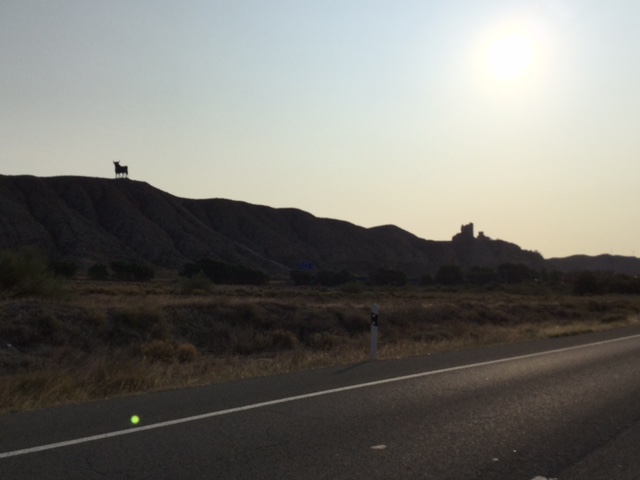
Next was Huesca - scrubby and bland, to be honest. Even those predatory birds which so frequently marked our progress earlier are absent here. Only fields of maize or stunted bushes for company as far as the eye could see either side of the road, we crossed the Greenwich Meridian, marked quite clearly with a large arch over the road in the middle of bloody nowhere, not long after the Sat Nav had told us rather blandly to ’stay on the E-30 for next 239km’. OK, we’ll do just that and… wait, what? 239km? Madre mia! This reminded me of the sign saying ‘Barcelona - 502km’ we’d seen the day before. I realise that there are far, far larger countries you can drive across, but I just never saw these kinds of numbers in Britain. And we were still a decent drive from Barcelona even at this point.

Bull silhouette and ruined castle on the road through Huesca.
Finally, into Catalunya. An impending referendum on independence may yet mean that, some day in the future, we’d be entering another country making this same trip. Certainly the road signs’ language changes immediately anyway. Traffic thickens as we near Barcelona itself, and after hundreds of kilometres of pretty straightforward instructions from the Sat Nav (don’t get me started on ‘her’ pronunciations of all the place and road names, which had my missus laughing openly more than once), we really did need her direction to find our way around the famous city.

With an hour to kill before we needed to put the car on the ferry, we had time to have a quick walk around the Barrio Gótico and Las Ramblas and buy some snacks for the final leg of the journey; the ferry crossing to Mahón. The Ramblas were just as I remember - crowded, with people from all over the place speaking numerous languages, over-priced craft stalls etc. The recent attacks seem to have failed to keep people away, just as they did in Paris, London, Berlin and pretty much anywhere else I can think of. There was, though, as we got back to the car to await our call to board, an extensive police presence at the port itself, holding people up who’d come in from Algeria as each and every car was checked thoroughly. I don’t know if this was the case before the attacks, or if it represents a sort of Islamophobia that is just what the terrorists are looking for, but it certainly looked to my eyes to be a marked contrast to the ‘business as usual’ look of the Ramblas.

I’m typing this on board, though I’ll have to wait to upload it. The Med is, as it always seems to be, calm and blue. The crossing will take seven hours, and we’ll be in Menorca, where we’ll spend the next couple of weeks hopefully catching the last of this year’s sun. Then we’ll have to work out where to stop while doing the same journey back across Spain, this time east to west.

Saturday, 26 August 2017

Cowpats and conviviality

Pretty much no matter how small your community is in Spain, you can usually be reasonably confident that there's somewhere even smaller not too far away. I've seen news items here which have featured a single, usually elderly, person being the last remaining inhabitant of some minuscule settlement. Everybody else has either left or died, the population slowly eroding to one last man or woman, who has no reason to leave their lifelong home.

Castiñeira is not quite that, but it's much smaller than Viana. This tiny hamlet sits near the very top of the local mountains - the drive there is uphill absolutely all the way. There are no shops, nowhere to drink other than the local residents' association bar in the room of a house, and no pubic transport there. Its small size has not stopped it holding its own fiesta, though, and we were invited yesterday to attend this celebration and have a bit of lunch at the house of a friend who comes from there but, fairly typically, has moved away - in his case to London.

Its altitude gives it some stunning views over the valleys below. It's quite a pretty place itself, with stone houses on steeply angled and narrow streets, all sitting right in the middle of the land which the people who live there farm for their living. Sheep and cattle regard you with cool indifference from behind dry-stone walls as you pick your way around, and the cows have left the usual tell-tale signs of their presence pretty much everywhere.


The event comprised a 20-litre tub of sangria and a visiting three-piece laid on to provide the music. 'Style', led by a chap who looked quite startlingly like Armando Iannucci, and evidently used to entertaining small gatherings like this, were taking no chances; they'd brought their own applause, cleverly hiding hundreds of fans within the speakers to reliably mark the end of each song. Their stage was quite literally the back of a van, the side dropped down to reveal the entire set. Our man Armando was quite a musician, somehow managing to play piano, drums, bagpipes, castanets and violin despite appearing to have only a digital keyboard in front of him.

However, what they lacked in spectacle they more than made up for with volume and an absolute certainty as to which music was required. At first, everybody just stood there under a hot sun and looked at them, and I thought it was going to be a bit awkward to be honest. However, just a couple of songs in, two things started to work their magic. First, the free sangria. Second, much more importantly, the Spaniards' almost compulsive desire to dance. Soon much of the crowd, which numbered the majority of the population of the village, was doing the Paso Doble to a string of what I've already seen during multiple visits to Galicia, are old favourites.

Slowly, though, the crowd started to drift away in twos and threes - past 3pm, lunchtime was at hand. A few non-verbal signals essentially told the band to knock it on the head for now, and we went to our friend's family's house for the standard four-course, far-too-much-food, stuff-yourself-to-the-gunnels-and-then-burn-it-off-with-home-brewed-fire-water lunch which marks these August holidays.

I frankly have no idea if Estilo came back for a second part of their set - we were so full of food that we didn't move for some time, sitting around the dining table to talk and have coffee. This ritual, known as sobremesa, is almost as important as the food itself here and deserving of its own entry some day. Casiñeira may be home to only around 70 souls, but the warmth of their welcome and hospitality would stand for ten times that number.

Tuesday, 23 May 2017

There's a change coming

So, months have passed since my last blog entry. It's not like there's been nothing worth writing about - the current diplomatic crises, particularly with Russia and North Korea, our own political shambles and forthcoming election, the ongoing crisis in the NHS - I could go on. But when the will's simply not there, it just ain't there. That sense of despair I wrote about after Tump's election has manifested itself in my turning away from the news - for the first time in my life - and largely ignoring it.

I've still known what's been going on, of course; in the West the news media is all but ubiquitous. But that knowledge has only been broad strokes. I haven't really paid attention. Instead, I suspect like a lot of people, I've focused on personal stuff, and taking great pleasure in things that have gone well in my own life and those of the people I care about.

One of those things has been a long time coming, but is now in the process of happening. For about two years my partner and I have been seriously contemplating selling up in London and going to Spain permanently. We could see all too clearly what some of our family members are experiencing having worked hard all their lives, and hoped to avoid the same if possible and buy ourselves a little more time off work, as it were, than they've been granted. My own father died less than two years after retirement, and for around 18 months of that he was ill. My mum's stroke, which has left her partially disabled. My partner's mum is not in the best of health either, having worked bloody hard herself just as most people our parents' generation did.

Add those personal reasons to the broader stuff above, and you'd probably think we've got a pretty compelling desire to get 'out'. Well, it's a bit more nuanced than that, of course, as I'll explain below. It's taken a year to sell the house - thanks a lot, Brexit - but it's done. We're currently in Sussex, working our notice periods and getting ready to take car and cats out there. The contents of the house are already out there - more on that particular adventure in another entry. It's nearly done. I have two days' work left as I write this.

I've written in these pages before about the village where we're going to live. The work/life balance, the pace of life generally, the character of the people, the tranquility - all are considerably different to London. This is one of those chances that you have to take, I think, if the opportunity presents itself. We know what we're moving to - Viana doesn't change. It's probably not going to for the rest of our lives. Not much, at any rate. Therein lies the appeal, of course. But therein also lies the apprehension.

I said to my workmates, before my leaving drinks last Friday, that I'm extraordinarily fortunate by any measure. I've been blessed with a happy childhood, loving parents, friends that I'm proud to so name, jobs I've enjoyed. Sometimes. A partner I can never adequately live up to or properly explain her meaning to me. I've not suffered poverty or serious ill health. And anybody who knows me will know that I'm baling out on Sussex just as my football team has finally reached the top flight again after a 34-year wait. Complaining about pretty much anything at the moment would be self-absorbed to the point of solipsism and churlish in the extreme. So to be in a position to choose to make such a monumental change, to give up something that's so good anyway. maybe I'm pushing that luck?

What's swayed us, if I can speak for both of us, is the micro and the macro. That personal stuff gave us the initial trigger, and then what's going on at home and abroad seemed merely to serve up daily reminders that it was time to go. The country moving farther to the right, with a convincing Tory victory seeming likely (assuming they don't trip over their own feet as they seem to be doing their utmost to do). The appalling response of some Brits, both triumphalist and xenophobic in equal measure, to the referendum result. The erosion of the sense of tolerance and modern thinking that has always formed part of my pride in being British.

But, in London, and both working, we've been largely insulated from feeling those things personally. It's been more of a prickling sense that things aren't right out there than a jabbing pain of specificity. We've had it pretty good here compared to most. Even my partner, who's returning to her own home town in this move, has admitted to a sense of loss. Leaving a teeming London, where your door is locked overnight but anonymity is blissful and opportunity everywhere, for sleepy Viana, where your door never needs locking but everybody knows everyone else's business, will be a seismic change.

Locals have warned me about how hard it is over winter. Long, dark nights. Cold. Not seeing the sun. (I have to misquote Billy Connolly here - where do they think I'm from? Benidorm? Brits go whole summers without seeing the sun...) But the summers there are long, warm and reliable. We'll be able to travel. Getting back to Britain to see family and friends is cheap and relatively easy. If you're a child, or of a certain age where yoof stuff is no longer important, there can't be too many better places to be than Viana. We hope our friends will come and visit us, so we can share out just a little of that good fortune in our own hospitality.

So there may not be too much happening to us specifically which prompts me to write here, but who knows? I have so much to learn about leaving the London mindset behind permanently and settling in to another culture, that it may prove a rich seam. I'll keep you posted.


Edit: having just posted this, I've just seen the appalling news coming out of Manchester. Exactly the sort of horror that only happens in places where the shock value of it can be maximised. The likely ages of the victims of this atrocity, when they come out, are going to make unbearable reading. My thoughts with families and friends of everybody affected up there.

Tuesday, 19 May 2015

Dogma, pedagogy and helicopters.

It's been that long, I realise, since I wrote anything on these pages that it must have seemed like I'd given it up forever. It becomes an easy habit to break, this, and with every week that passes without a new entry, a harder one to re-establish. The longer it goes without an entry, the better it's got to be when it does finally reappear, right? At least that's how it feels from this end.

So, finally dipping my fingers back into the murky waters of the typing pool, you'll forgive me, I hope, if this one falls rather short of the standard that might be expected after a five-month hiatus, for that is what it's been. (I genuinely hadn't realised it had gone that long).

So, comment on general election to come. Clegg's tears, Miliband's rather startled realisation that his brother should have got the job all along, and Farage's defeat will no doubt feature. See if you can guess, before I write that entry, which one of those three things gave me the most pleasure. In the meantime, a bit of comment on what Danny Baker might call the Iron Horse of this blog, the good old Catholic Church.

I've had the very good fortune these past couple of weekends to head out to Spain for each of them. It may seem a bit la-di-dah jet set to fly out on a Friday, back on a Monday, out again on a Thursday and back once more on the Monday, but that's how it fell. First for a wedding, then for a birthday celebration. I've written on here before about Spanish weddings, I think - their length compared to the British ceremonies I've attended, never having to pay for a drink at the reception, the very Spanish music partnered by dancing late into the night. Then there's just how, well, Catholic the actual ceremony is. This usually includes a sermon, in both senses of the word, and the one delivered by the priest administering the wedding I attended a couple of Saturdays back was an absolute doozy.

I usually hear my girlfriend, a fervent atheist brought up in a Catholic country, muttering in quiet disagreement during these ceremonies as the priests do their thing. On this occasion, though, she actually felt moved to get up and leave the church mid-way through the thing, ostensibly to assist a mum with one of her two babies, who'd started fussing a bit - who can blame them? - but really to cool her anger at what she was hearing. My Spanish has not come on sufficiently to follow everything said at these occasions, especially when it's punctuated by the typical call-and-response refrain of the church's own peculiar argot.

Her later explanation was that the priest had had a bit of a go at parents who leave it to teachers to educate their kids. Teachers, he'd explained, merely teach. They can't educate - only the Church, through their parents, can do that. So all this stuff the schools fill kids' heads with can't be allowed to take root as incredulity, as questioning, lest they veer from the perfect truth of the Church. As a former teacher, this was basically the perfect storm for her, so out she bailed, for a while at least.

All ended well, though. They got married, there was dancing, and I got completely shit-faced because a) the bar's free, remember, and b) you always forget they don't bother with measures like we do, so you're getting at least a treble every time you order a short. The hotel room was doing the helicopter thing when I crashed into bed at who-knows-what hour of Sunday morning, knowing I had to be back at work Monday afternoon and recovery time was therefore short.

This weekend just passed, however, was completely different. I got completely shit-faced at a birthday party instead, and the spare room of the house I was staying in was doing the helicopter thing as I crashed into bed at who-knows-what hour of Sunday morning, knowing I had to be back at work... you get the idea.

What did I learn from these occasions? Well, it might be a good idea to get wasted before any subsequent wedding ceremony I attend out there. The church may do the helicopter thing while the nuptials are going on, but I've noticed that my confidence in my Spanish is correlative with the amount of alcohol I've consumed. So have a few early doors and I'd at least think I could understand the sermon sufficiently to understand what my missus is muttering about as she stands next to me.


Monday, 27 February 2012

If you're going to do something, do it properly

Two themes dominate Spanish news and conversation at the moment. One is the lack of rain – it's been an extraordinarily dry year there so far and there is a severe danger of total crop loss in some regions. One area which had 195mm of rain in the first three months of last year has so far had 2mm this year, for example. A genuine worry and another sign, if any were needed, of the increasingly rapid changes to our weather patterns.

The other is the alleged mendacity of the King's son-in-law, one Inaki Urdangarin. More details here, but one datum which is missing is the size of the alleged misappropriated pot. Spanish news channels claim up to €17 million is missing and there may yet be criminal charges. The case has divided opinion in Spain along the lines you'd expect in a country where left and right are politically still much more clearly delineated than they are in Britain. He's been condemned as a thief by an already convinced left, defended as innocent until otherwise proven by a more pro-Monarchic right. It's a case which promises huge ramifications for the Spanish monarchy already, even more so if it turns out he's a criminal.

What struck me, as usual, though, was an odd side-effect of this story. Spanish celebrity culture makes our own seem like an amateurish, high-brow, passing fancy. In the birthplace of Hello magazine, this case is manna from heaven for the countless gossip channels (yes, channels), magazines, newspaper columns. On shows (nicknamed tertulias, though the word has much more genuinely artistic roots than the sort of telly it now applies to) filled with z-list celebrities – often former Big Brother contestants, to give you an idea – people literally yell and scream at each other about the latest celebrity scandals. Often they will invite friends and relatives of those involved on to the show, so they can yell at them too, and show clips of other shows in which to give yet more z-listers a chance to respond to, or with, some slur. And so the cycle of self-feeding continues. It makes Jeremy Kyle's show look like Melvyn Bragg discussing poetry with Will Self and Will Gompertz. High-brow it most certainly is not.

On one occasion last week, around lunchtime, one such show was in full swing. Two lines of four guests, I have not the faintest idea who any of them were, faced each other and variously sat, stood, pointed, gesticulated and sulked as they exchanged opinions on the Urdangarin scandal. I cannot understand a word of this as they all shout at the same time, and we were going out anyway, so we switched it off. We went out, had a coffee and a chat with friends in a bar, went for a quick beer and another chat with more friends in the village square (it's that sort of place), then went for lunch. A leisurely lunch was followed by another coffee in another bar, and then a few frames of pool in yet another bar. (It's that sort of place too). When we came home some hours later, the same show, with the same host and the same guests, was still on, talking about the same thing. Indeed they were now showing clips from a few hours earlier in their own show to invite comment from yet more guests, and the people who'd been on there all along.

That kind of commitment to celeb gossip, to scandal, and to shouting at each other, is awesome in its way. I have nothing but disdain for this kind of thing but at the same time a kind of grudging admiration for just how sedulously they go about it. If this were British TV, at some point, a real programme would have to be put on, and not much short a royal wedding, or the death of a Royal Family member or serving PM will clear the airwaves in such a fashion.

I'm due to return to Spain in July at some point. I can only wonder if the same show, with the same bickering, exhausted, furious, empty-headed panellists will still be going at it then.

Life imitating comedy

I've spent the last 10 days in Spain, of which more in another post. The first seven or so of those ten I'd spent in some discomfort, let's say pain in fact, with what felt like a trapped nerve in my shoulder. Therefore, as part of a couple of days spent in Valladolid, the old capital of the country in the days of Felipe II, it was arranged that I see a physiotherapist who'd helped my girlfriend's mum when she'd been rendered all but unable to walk with a similar problem in her hip.

My girlfriend came in with me, to translate, should it be necessary. As it turned out, my pidgin Spanish (and, OK, his flawless English) saw us cope alright – she needn't have been there. That made her all the more pleased to have remained in the room given what followed. I'd had my shirt removed, of course, not a pleasant sight as it is, so I'd been variously sitting on the edge of the table, laying face down, laying face up as instructed, in such a state while he worked his arcane stuff.

About 40 minutes in, I was invited to stand up, move to the end of the table and then sit down astride it with my back to him. I'd rather lost the inhibition inherent in sitting with no shirt on because I was already starting to feel the benefit of his work, so I sat down confidently, directly facing my girlfriend at the other end of the room.

There followed what can only be described as the sit-com sound of the loud ripping of my jeans, as they split in farcical fashion, right across what would delicately be called the nether regions. I looked up in shock at my girlfriend, who was unable to breathe, absolutely helpless with mirth, mainly at the face I was evidently pulling, the memory of which it seems will sustain her for some time if she needs a laugh.

Now here's the thing. I'm a fairly reserved individual, easily given to embarrassment at my own public misfortunes. So this is something I can easily believe reddened my face considerably. But what was actually running through my mind was that I had on, basically, a pair of comedy underpants. Let me explain. We're fortunate in having a house in a beautiful part of Spain, in a small village in the Galician mountains overlooking a lake, in a region not unlike the Lake District. There are few people there, so there are few shops. The market comes twice a month and it's a major event, with everybody from the area around the village coming to shop, to exchange gossip, to sell their home-grown food.

This is where many people buy their clothes. I do not take many clothes out there when we go, preferring to travel as light as possible and keep clothes in the house, but this compels me in some cases to buy clothes at the market. Carnaby Street it ain't. The clothes are not there to satisfy the whims of the fashion conscious. I had been unable to buy my preferred plain, black boxer shorts, so had instead assembled a stock of garish, multi-linear, multi-coloured boxer shorts of varying degrees of tastelessness, because that's pretty much all there's been available out there when the market has come.

Therefore, on leaving the physio's premises, I had to walk the busy streets of Valladolid with my coat held in front of my body to hide my shame, and find a menswear supplier who could outfit me with replacement trousers.

I shall, I think, check in a bag next time we go and, take a stock of black clothes out there with me. I will, after all, have to hold a funeral for my stone-dead pride anyway.

Saturday, 24 July 2010

Born once, get one free

It's my girlfriend's second birthday today. She's not the queen or anything, but she is Spanish, and they have a handy second birthday because most Spaniards are named after saints, or at least have the same name as a saint. On the day of the saint after whom you're named (or at least whose name you share), you get presents from friends and family. If they remember, that is. I usually have to remind her mum because she's a bit rubbish.

Anyway, she's in Spain for a few weeks at the moment so I hope you'll forgive this self-indulgent post.

Feliz santo, guapinha. Besitos.

Monday, 12 July 2010

Joy and Spain

Just got back from a week in Galicia, having been out there for a holiday with mates, and had the pleasure of watching the World Cup quarter- and semi-finals there. The Spaniards always intrigue me with their muted response to winning these games. I was also out there for the quarter- and semi-finals of the European Championship they won a couple of years ago, and their response to their wins in those games was identical. They were extremely pleased but muted by comparison to English fans. In 1990 when England won the quarter-final against Cameroon there were thousands of people on the streets of Brighton, dancing in the fountains, generally ecstatic. No such response out there, at least where I was. Maybe it's a feature of the Galician nature that they only actually go properly bonkers when they win the whole thing. It's almost as if they don't want to believe it's going to happen until they actually see it.

I pointed out that if England ever actually reach, let alone win, a World Cup Final these days, there would be, with apologies to the great Bill Murray, buildings aflame, anarchy on the streets, dogs and cats living together, human sacrifice, mass hysteria. Nothing like the quiet satisfaction I witnessed during both the Euros and the WC. My only regret is that both times I've had to come back on the day of the finals themselves, so have missed what happened when they actually won them.

And, for me, the best team won. They may not have played the scintillating football they're capable of, they may have scored very few goals, but they've been the best team in the world over the last few years, they can play some breathtaking stuff, and the right team won on the night as well I think. Holland, for all their berating a ref who did his best to retain some semblance of a game of football in a morass of dissent and thuggery, would have more right to complain if they'd actually tried to play some football occasionally. They've also got players of very high quality, especially technically, but it felt to me like they were paralysed by fear of losing. They could easily have finished the game with fewer than the 10 they did finish it with. Total Football it bloody wasn't.

One happy bonus on the flight home, though. Flying over the Sussex countryside, and a left turn above Brighton, giving me spectacular views of the new stadium under construction. What a glorious site that was for an Albion man.

Thursday, 24 June 2010

Humanity, humility

My girlfriend's gran, on whom she doted, passed away last week. I'll say a word about the lady herself in a moment, but something I was told about what followed has prompted me to write a bit about the Church. I should warn you, if you're a Christian and you're offended by anti-Church sentiment, not to read this post any further. I am keen to express my strong views on this matter, but I'm not seeking to offend or upset anybody for their beliefs.

So, my very upset girlfriend takes a flight to Spain at about 6 hours' notice, to attend a funeral I was regrettably unable to make because of work. Her gran, a naturally and devoutly religious woman but not a church-goer (this is not something in which I see a contradiction, by the way), had told her what she wanted to happen when she passed. Part of the instruction was that she did not want a service with a priest, least of all one who never met her. However, this being Spain, I suppose it's not that surprising to know that a priest was indeed involved as things turned out. Early in the service, I'm told he crossed himself, an act which was repeated by the entire congregation. Except, that is, my girlfiend, like myself zealously atheist, and her sister, whose views I've never sought on this.

The priest clearly took this quite badly as, following this, he evidently issued a sermon which addressed the fact that non-believers are destined for hell, and looked firmly at my g/f and her sister. This went on so strongly and so pointedly, that barely any reference was made to the woman for whom everybody was gathered there. Now I appreciate that the man may have believed he was making an effort to save two souls, but to use this opportunity, while the bereaved people he was addressing sat there mourning a beloved grandmother, epitomises all that I can't stand about the Church. Where was his common humanity, to think not of their spiritual souls but of their very real and human grief, and to address that? In Spain, old people are treated with a respect, even a veneration, that's often lacking in Britain. He decided to throw that convention out of the window to preach a religious dogma at people who were not there for him, or themselves, but for their gran. How arrogant, how presumptious, and above all how disrespectful to a much loved 97-year-old woman who deserved better. And may indeed, given her instructions on what she did or did not want for her own funeral, have had the prescience to see something like that coming.

Such occasions make me glad of my atheism but despair that people can't mourn or celebrate a loved one out of the pure and simple humanity of their own hearts without having a religious message shoved down their throats. As for gran herself? A tiny little bundle of love and happiness, who had lived through a civil war which forced her husband to flee to France for his own life, and hardship that most uf us could not begin to imagine from the comfort of the 21st century, however hard we may think we have it now. She loved to dress smartly and go into town to exchange gossip, and listen to people tell her how beautiful she still was, even in her nineties. Fastidious, house proud, loyal to her family, she carried the old-fashioned Spanish values of frugality, loyalty and respect for others lightly, and was adored by her daughter and grand-daughters, who cared for her right to the end. The world is worse off to the tune of a 4ft Spanish matriarch. Rest in peace, Maura, reina. You've earned it.