Friday, 5 July 2019

Playing away

The village of Mamoiada sits in the mountainous interior of Sardinia, a place of around 2,500 people that you're probably hearing about for the first time in this entry. I certainly knew nothing of it before being invited, with a group of over 20 others from Viana, to take part in what's a hugely important cultural event for them, which in recent years they've hash-tagged #mamumask.

Getting a crew of half a dozen boteiros, eight drummers and assorted aixada players from Galicia to Sardinia is not a cheap or simple affair - two enormous wooden containers were required for the drums and equipment. But their own Carnival is as important to our Sardinian hosts as our flour frenzy is to us, so with the help of a dedicated set of volunteers and partly funded by grants for cross-cultural initiatives, all the gear was safely packed and sent, and flights and accommodation provided.

We happy few. This pic mainly notable for the extraordinarily
rare occurrence of me posing willingly for a photo that
is not being taken at a wedding. Pic: Canillo
The village features a renowned mask museum, and masks play a central role in the culture of the area. A guide took us round, showing us costumes and masks from carnivals and cultural events all over Europe. We were startled to find an entire boteiro costume from Vilariño de Conso, just 10km from Viana, standing to attention within. Other costumes from Greece, Germany, Russia and others displayed many similarities in terms of the materials used, their common features (carved wooden masks, animal horns, charcoal, long staffs etc), despite these costumes coming from very different cultures and being used in festivals with very different origins.

The big day (for us at least) was Sunday. We'd been wined and dined handsomely on Saturday, and we'd given the locals who were out on Saturday night a bit of a preview, without boteiros in full kit etc. On the Sunday we were taken up to a nearby vineyard and took our fill of local wines, cheeses, cold meats and chutneys, only to then be told that this was an 'aperitif' before a four-course lunch. There was time to enjoy that lunch and relax for a couple of hours before we had to get ready. The boteiros had to dress thus: a white shirt, black tie* under a thick sweatshirt onto which several thousand feet of ribbon has been sewn. This is not an exaggeration - just look at any of the photos. Long, red satin trousers under high black boots. A belt studded with bells. White gloves and a two-metre pole, called a monca, complete the set. Oh - almost forgot. A wooden mask and headgear, weighing anything up to 15 kilos, goes on the head, strapped on tightly.

Their task, to run up and down alongside the fulion, keeping the crowds back and entertaining them. In 32ªC. The start of the parade was delayed a couple of hours for the temperature to drop a bit, but I was carrying just an aixada - a shovel head - and hammer, and wearing a white cotton shirt and jeans, and I sweated like a Palace fan in a spelling test. The boteiros were all, of course, young'uns, but we were followed all the way by water-toting volunteers, hydrating the lads with straws poked through the mouth parts of the mask. Bottles for the rest of us, thanks.

If you don't bloody your hands and the drum skin,
you're not playing hard enough. Pic: Pedro Garcia Losada
We followed the locals' own traditional figures, themselves wearing thick furs with 30kg of bells on their backs. There's a long video here, which will show much better what I'm going on about. You can hear us long before you see us, but we come in around the fifteen minute mark. There is, as you'll see, a 'piccolo incidente' when one local got too close and was dragged to the ground when she got something caught on the boteiro's shirt. No serious harm done but if you don't heed the warning about why the boteiros are there, this can happen.

Heavy, sweaty work. Pic: Pedro Garcia Losada
We were at this for about three hours. I've stripped the skin off my right little finger, index finger and thumb, with unpleasant looking blisters growing nicely. I have no feeling on the fingerprint bit of my left middle finger. My shoulder ligament keeps popping up and down uncomfortably. But bloody hell, it was great. I had no idea there were quite so many people watching because I was so intently concentrating on the lead drummer/aixada players, desperate not to be the one to fuck up any fulion beat.

We ended up drumming in the courtyard of our own hotel at the end of it all, before spending a night on the town during which it was all but impossible to pay for a drink. 'The Spaniards don't pay', we were told repeatedly. This led, as you can imagine, to long nights and sore heads among some of our number. I'm told the boteiros, stars of the show and already called upon to pose for countless photographs, did their bit for Italo-Spanish relations over the course of the evening. They certainly looked like they'd had a tough night when we were taken to a nearby beach for the following day.

Jorge, the man who sells the aixadas we were playing and who was the driving force behind organising things from our end, was presented with one of the Sardinians' masks as a mark of thanks, in what was an emotional send-off at the end of it. He said that Galicia is known widely as being hugely hospitable but, compared to the extraordinary generosity and kindness we were shown by the good people of Mamoiada, he held us only as high as his own shin in that respect. Even the apparently infinite pizza (again provided free, again with free beer) served at the farewell dinner was possibly the best pizza I've ever eaten. And it's not a small sample size, let me tell you.

An invitation to reciprocate at next year's Mascarada has already been extended to them. We hope to be as hospitable, friendly and generous as they were to us, but to be honest we've got our work cut out.

*The fact that the tie is entirely invisible when the boteiro is fully dressed is irrelevant. It must be so and that's that.

Monday, 27 May 2019

Cross no boxes

Unlike Britain, which went to the polls on Thursday, Spain's European and local elections were yesterday. This was my first chance to vote here - I'm ineligible in the General Elections - and we came back from O Grove, a couple of hours' drive away, to do so.

There are of course similarities with Britain - you see election posters all over the place, though not, I've noticed, displayed in people's house windows. Instead the council provides large wooden boards at strategic points around the village onto which all the parties post their campaign posters. What unspoken arrangement exists as to who gets to put theirs at the top, what stops them removing competitors' posters etc., is unclear to me, but they seem to be neatly arranged such that they appear alternately, as if all parties are trying to be polite. (Though I've been told that some naughty types do indeed sneakily remove other parties' posters in the dead of night. Tsk.) Since the local elections mean you're basically voting for somebody you know personally, most of them simply show a slightly awkward-looking local staring directly at the camera, and the party's name and colour.  On a local level, at least, I don't hear people talking about the PSOE, the PP or the BNG so much as 'Pablo', 'Andres' and 'Secundino'.

The local school is the polling station, just as is often the case back home. You go and identify yourself, you're checked against the list, you go into the booth to vote. One vote for European election, one vote for local mayor. There's no crossing of boxes, though - you pick up a slip of paper branded with the party of your choice, insert it into an envelope provided, and drop the sealed envelope into the relevant box. This means that a lot of the election bumph you receive in the mail during the build-up includes envelopes with slips of paper already in them, so you can just take that and drop it in the box if you so wish. Very thoughtful of them!

The count, unlike back home, takes place in the same rooms in which the votes do. Five classrooms were given over to the task, being grouped both regionally and by surnames - so Viana do Bolo, A to F for example. The doors are closed for the count but people gather in the hallways of the school and peer in through open, slatted windows. The envelopes are opened, the name of the party called out, and the score kept on the whiteboards in groups of five. So you can see a running total as the votes are read out. Regular 'shushing' is required to stop chattering spectators making too much noise for the count. The votes are also, of course, counted by observers and checked against each others' scores at the end to make sure they all agree.

A few envelopes contained no slip at all - the local equivalent of writing 'none of the above' on the slip, and one of them contained only a photograph of one of the candidates. Draw your own conclusions - it didn't count. A proportional representation of the votes left the council, as in so many other places, with no overall control. PP - think of them as the Conservatives - came out with four seats, PSOE - Labour equivalent - with three, and BNG - a sort of Galician Plaid Cymru - with four. Negotiations will now have to take place as to who becomes mayor and whether any two - realistically BNG and PSOE - can coalesce. It was extremely interesting to see it done somewhere else, despite a local copper and council member good-naturedly threatening to sling me out of the building because of Brexit. I voted to remain, I reminded them, earning me the right to remain to watch the rest of the 'show'.

Results across Spain, as in much of Europe, served mainly to illustrate increasing polarisation of European politics. Nowhere more though than in Britain. Seeing the results, I can't seriously believe that even committed Leavers find that boorish tosser Farage an appealing politician, but his party served to underline just how much anti-EU sentiment there is in Britain. (Or perhaps it's just an expression of 'Just get it done, for fuck's sake...) The rise of the pro-EU Lib Dems and Greens and Labour's incoherence on their stance, added to huge punishment of the Tories' own inabilities, made Britain's results as divided as anywhere that voted.

I've watched what's been going on in Britain with increasing apprehension, particularly given May's recent resignation. It's not that I think she was capable of doing a decent job of the Brexit negotiations - I defy anybody to navigate the conflicting desires of both sides of that debate with any success - so much as the fear of who might follow her. May at least isn't Boris Johnson, for example. She's been praised by all sides for remaining polite and calm, and I've always had some residual goodwill for her over her stance and work on Hillsborough. People have said she was dealt a bad hand and played it badly. I think she was dealt an impossible hand and played it no less well or badly than anybody else could.

What we may now get is some bug-eyed, foaming-at-the-mouth anti-European determined to pull us out of the EU under any circumstances. (Bloody foreigners! Keep the pound! Close the Chunnel! Ahh, India... If only we hadn't lost you...) The possibility that it may next be Boris to whom this most difficult negotiation is tasked, a man who already has a trail of gaffes, insults, casual racism and rule-breaking behind him, doesn't really bear thinking about. It was fun to watch him dangle from a rope slide waving flags in 2012 and all that, but hasn't his disastrous term as Foreign Secretary already demonstrated that giving him a real job is taking the joke much, much too far?

That the more moderate wing of the Tory party are already warning sternly against leaving with no deal or they may help 'bring down the government', and that such a thing is possible that people like Gove or Hunt almost look preferable to Johnson as next leader, shows just what sort of a shit-storm we're in the middle of.

It's all made last night's election here, which to some is simply about whether the road outside their house is going to finally be repaired or money can be found to employ another doctor locally*, for example, seem like much more of an exercise in real politics, frankly. Being there, seeing the count unfold, knowing the candidates and their seconds and thirds - it was actually fun. Who'd have thought?

*This is of course an over-simplification but it's that sort of stuff that motivates people here and can decide a person's vote.


Monday, 22 April 2019

Where are all the chocolate eggs?

A few years back an acquaintance of mine, appalled at seeing Easter eggs on the shelves before January was out (yep, really...),  posted a photo of same, with an eloquent comment, on his Facebook page. '"Fuck you, xxxx supermarket. Just fuck you." (I can't remember which supermarket chain it was. It doesn't matter really - the point is clear enough.)

Of course I agreed with the sentiment. About as egregious a piece of commercialisation as you'll ever see. But Easter is done rather differently here and I have to confess that the total absence of chocolate eggs on the shelves, be it January or the last few days of Lent, is itself something of a disappointment. Now I'm fully aware that even in a country as secular as Britain, Easter for many people remains an extremely important religious occasion. For me though, it's always represented a) waaaay too much chocolate*, b) four consecutive days without work and c) a double-fixture football weekend. I'm certainly not alone, I believe - most British people without a religious faith would be able to identify with at least one of those three things, I reckon.

Here, though, Easter remains as it's always been - an extremely important religious affair. If you don't attend church and don't happen upon the procession, you'd only notice the presence of more people in the village than usual as a sign that anything's happening at all. There are a few chocolate rabbits about in the shops, and I mean a few - but the creeping hand of Mammon has yet to really make its presence felt on Easter here. The bar owners will certainly see un uptick in takings for a few days because many of those who come here for Carnival, or during August for holidays, also make the trip home for Semana Santa.

The processions are, frankly, creepy to the irreligious. (Maybe to the faithful too - maybe that's the point. I can't speak for them.) I'm sure many of you have seen the images. The Virgin, or the image  of Jesus nailed to the cross or dragging it to his crucifixion, will be taken from its place in the church, hoisted upon the shoulders of the faithful, and carried around the town. In Viana the local priest, a young and cheerful chap by nature, followed behind, a megaphone in hand, incanting mournfully. I did happen upon the procession on Friday, I think it was - emerging from a bar as part of a group of ten, the lively chatter and general noise gave way to a respectful silence as it passed us.

I'm talking Old Testament. Real 'wrath of God' type stuff...
One for the Ghostbusters fans, there. Photo: Cristina Fernandez.

They vary slightly from place to place. At some, sorrowful music will be played - possibly even a funeral march. By far the most unsettling part of it, though, is something that's common to all of them; the outfits worn by the attendants. Long robes topped by high, pointed headgear, eyes peeping out of holes, conjure up images of one thing and one thing only in my atheist mind. I don't have to spell it out here, do I? If you're not religious you're surely likely to think of the same thrice-repeated letter that I am. If you are religious, doesn't this instil the fear of God into you in an all-too-literal fashion?

I'm aware, of course, of what they're commemorating. But this is, for me, the very definition of preaching to the converted. If you're a believer, you're likely to have seen these icons in the church already. If you're not, you're either at home eating chocolate or you're watching out of curiosity, for the sake of the spectacle rather than the sentiment. Why are they showing them around town? The point of commemorating in exactly this manner is rather lost on me in my ignorance. One impression is left very clearly, though, even in my know-nothing bonce: just how much more everyday belief there remains in people in Spain compared to the UK, even among those who don't necessarily routinely attend church.

Anyway, I gather that back in the UK the long weekend has, in a coincidence seen about as frequently as Haley's Comet, been one long glorious stint of unbroken sunshine and unseasonable warmth. Hot enough to melt your chocolate eggs, even. Now that would elicit some mournful incantations from your correspondent, let me tell you. However you've passed it - in church, being sick from too much choccy, spring cleaning (booo!) or on the beach(!!!), I hope you've had a happy Easter.


*I don't know what it is about Easter eggs, but the chocolate absolutely tastes different, and better, than in any other form. Given the choice between a Yorkie bar or a Yorkie Easter egg made out of exactly the same stuff, I'll take the egg every time. Brains are weird, eh?

Sunday, 24 March 2019

For whom the bell tolls

On a warm and sunny Sunday such as today, with a billion tiny jewels of light winking in and out of infinitesimal existence on the lake's surface and the almond and cherry trees in bloom, this is a spectacularly beautiful place. It's a quiet beauty and Sundays are particularly still, even by Viana's standards. There will be a few people about having vermouth around what Brits would call lunchtime, enjoying the sun at a table outside one of the bars, but you could easily walk around the parts of the village away from the main square and see nobody.

That quiet, and the village's small size, is often reinforced by the one sound other than birdsong that you can reliably bet will intrude into the hush - the church's bell. In Britain we've all heard them chiming the hours, of course, whether it's the currently silent Big Ben or the local church bell, but here the bell has other jobs to do, and the fact that its sound can be clearly heard across the whole village enables it to do those jobs most effectively.

It of course marks the time on the hours and half-hours but at noon on Sundays it can also be heard calling the faithful to mass (at the same time, discordantly, that it chimes the noon dozen). It also serves a much more poignant purpose. If you hear the chime in the video below, you know a funeral has just started or somebody has died. The sound is appropriately mournful and, despite the large number of children in the village at the moment, it's an ageing population on average, so it's heard regrettably frequently.


(Excuse my fingers.) 

Despite the sad use to which it has to be put, I find the bell to be a reassuring presence in general. In the absolute silence of night here, if you can't sleep, it sounds through the dark like a nightwatchman, marking your wakefulness in half-hour increments. Where some might find that disconcerting, I find it a comforting indication that all is well. It even has the common decency to ring the hour twice, the second time a minute after the first, so if you're only half aware of it ringing (was that five or six?) you know you've got another chance to listen properly in short order.

I'm told that once upon a time the bell performed warning roles, letting people know if there was a fire, flood, plague of locusts or whatever. Nowadays we have a shiny new alarm, tested every few months, which will alert us if the dam upstream fails and we have to get to the high point of the village pronto, but how you were supposed to tell these warnings apart back then I can't tell you. Not knowing if we were about to be burned to a cinder, drowned in a muddy torrent or eaten by zombies (I'm assuming they'd have tolled it for the zombie apocalypse...) I'd probably just run around doing this:

until some professionals turned up to deal with it. So I'm more than happy with just the three jobs it does now, thanks.


Thursday, 7 March 2019

The sardine has exploded - it must be all over for another year.

So, the big finale. In Brazil, they mark Mardi Gras with huge, glamorous parades and elaborate costumes. In New Orleans they throw beads into the crowd, decorate coconuts and bake cakes with tiny baby figurines in them, purportedly to represent Jesus. Here, the flouring reaches its epic climax, the folion all come together for the burning of the lardeiros and a funeral is held for a giant sardine. (I know. I'll come back to that later.)

I've never been to Glastonbury but veterans all seem to talk about the mud years. Well here in Viana the rain, if it comes on the Tuesday as it did this year, turns the ground not into mud but glue. We'd been lucky so far this year but on Tuesday it absolutely shat down, thinning the numbers who'd usually attend - people don't want to ruin €300+ drums - and ensuring anybody who did attend will be picking rock-hard globules of solidified flour out of their hair and ears for the next couple of days, regardless of how assiduously they try to wash them out.

The lardeiros, as I've said in earlier entries, are the Carnival made manifest, and they're set ablaze at midnight on Shrove Tuesday (or Mardi Gras, or Fat Tuesday, or whatever you want to call it), bringing the flour attacks to a close. As you can imagine this makes people go all out to get the last flourings in for another year. Usually pretty much anybody who has a drum or an aixada will be there, beating the folion as the Lardeiros burn. It's a pretty visceral experience even when the square isn't completely packed because of the weather. This film is from 2012:


The world feels like it's shaking with the noise - the thunder of drums and trowels being struck is absolutely deafening. Bangers and aerosols placed inside the effigies pop and explode while this is happening. How are they set on fire? I'm glad you asked. In a move which would give any H&S exec in Britain palpitations, a bloke who may or may not have had a couple of cold drinks himself is hoisted up to the figures on the back of one of those telescopic platform things, soaks them in something highly flammable like petrol or whatever it is, and then torches them using a long, burning stick from the ground.

And how they burn. What remains is often still smoking well into the next day:

Ouch. Gonna need some cream on that.
Photo: Emilio Ortiz Rodriguez
If the bars were busy on the weekend, they're absolutely heaving on Tuesday. One or two of the bars' owners take the opportunity to close for the night, or part of the night, to have one Carnival night out themselves, forcing more people into fewer bars. I knocked it off at about 2am this year but for most people this is the night that goes on 'til 7 or 8 in the morning. There's usually a band - cancelled this year because of the heavy rain - and a costume competition, and they don't even start until after the lardeiros burn.

Wednesday marks an almost instant return to the village's usual quiet. Immediately there are noticeably fewer people about and the streets are cleaned of the flour. Most bars are closed for a clean-up which takes a good couple of days, and some remain closed for a few days' well-earned rest. It just leaves the sardine funeral to the year-rounders or the few who hang back beyond the end of Carnival.

Oh yes, the sardine funeral. In another pyromaniacal episode, a six-foot-long sardine, constructed of a cage wrapped in tin foil and, once again, filled with explosive materials, is mounted on a trailer and paraded through the town. Locals follow, in funereal black, lamenting the sardine's passing. When it reaches the designated spot in the Cabo da Vila, the old town surrounding the castle, it burns in similar fashion to the lardeiros while people stand ludicrously close to it and await the comestibles. Free red wine is distributed liberally, and real sardines - barbecued on an enormous fire at the scene and served on bread - are consumed in large numbers.

At the end there are torrijas, a sort of cinnamony French toast. These are not much to look at but they're absolutely delicious and many of the locals make them, meaning each one you sample is slightly different from the one before. I can't tell you how many of these I can wolf down but my record doesn't bear imparting here, on account of the shame it would bring me to report it.

A stroll back down the hill for a coffee in the nearest bar and that really is it. All over bar the blogging, until the sound of the folion beats over the village early next year and heralds the coming of another Carnival. The locals hold a funeral, I think, because they feel genuinely sad for Carnival's passing. Its importance to them finds arcane expression by this burning of the sardine effigy, and if that doesn't seem to make any sense, then you need to come out here and experience this for yourself to see what I mean.

Tuesday, 5 March 2019

Waiter? I say? There are bones in my sausage and my liqueur's on fire.

I mentioned that Sunday is a big day in Carnival. It's oddly timed, following (as Sundays tend to) what for most people is a long, boozy Saturday night, but that's just how it goes at this time of year. Deal with the hangover, get up to the town and partake of the hair of the dog which bit you. You can't miss the parade.

Viana do Bolo is the name of the county, for the want of a better word, in which our village sits, as well as the name of the village itself. It actually comprises around 52 villages of varying sizes, ranging from tiny hamlets of just a few dozen people up to Viana itself. In terms of geographical extent, Viana do Bolo is actually one of the largest counties in Spain, albeit one of the least populated. Many of those villages have their own folion, their own drum beat, and they go visiting each other during the week to drum and enjoy the hospitality, given freely, of the locals. But on the last Sunday, everybody comes to Viana to join the parade.

Each village's folion will come down behind a banner proclaiming from where they've come. From the top of the town they come down through the village, stopping to drum at the main square, and then up to marquees alongside the sports hall for a lunch laid on by the council. Many of them come in bright costumes, and some also put together a carroza, what we'd call a float. That is to condemn the things with a wildly inadequate description, however, because some of these can be absolutely extraordinary. The good people of Quintela can usually be relied upon to deliver here.

This tank, which fired sweets at everybody, is from 2015:


And this, in my view the most spectacular of all, is from last year:


I have no idea how long these things must take to put together but can only imagine they work on them all year. This year's carroza from the Alternativos, a group from Viana itself, was a merry-go-round mounted on the back of a car, revolving as they went. Amazing work, done out of a love of Carnival and for no other reason.

You also get a decent look at the boteiros in the first video, whose crowd control job I wrote about in this entry. As you can see the square is rammed. This is pre-lunch, so there's a roaring trade in vermouth as well as beers and coffee. Many of the bars lose a decent percentage of their glasses during Carnival because people buy their drink, take it outside and never bring it back, moving on to another bar as is the custom here. It's clearly worth the losses, though, because there are more customers about now than at almost any point during the year.

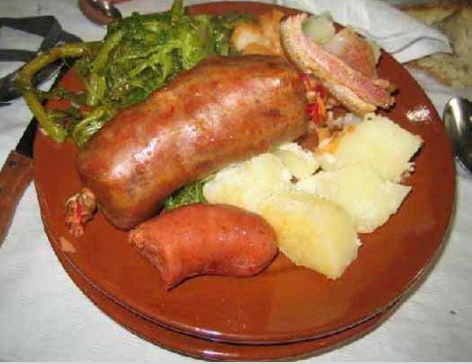
So, to lunch. As I said, those in the parade have grub laid on for them, but everybody else has to make their own arrangements. Many try to cram in one of the few local restaurants. Others have a big feast at a friend's house, gathering in a bodega. For those fortunate enough to have been able to secure tickets, it's the Festa do Androlla, which will be celebrating 50 years in 2020. Androlla is a large, reddish sausage, spiced with paprika. It's a local thing, hugely popular here, but wouldn't be to everybody's taste I think. It contains, you see, large chunks of bone, better to infuse the thing with flavour. It also turns the water in which it's boiled for an hour and a half a deep, bloody red. For the squeamish it isn't. It's typically served with grelos (turnip leaves) and boiled potatoes, but is only one of four courses at the Festa.

So about 1300 people gather in the local sports hall, to enjoy soup, then the Androlla, then lacon, a salty, gammony bacon, then bica, the local cake. Each of these courses is repeated - that is, the dozens of waiters serving the long tables come round with them offering seconds each time. This is supposed to start at 2.30 for a 3pm opening course, but this is Spain after all. The parade will last over two hours and usually runs late anyway. This year's first course was served at almost 4pm. People don't seem to mind too much - there's wine on the table and friends to catch up with.

Androlla, grelos, spuds, chorizo and lacon. Twice.
Plus three other courses, obviously. 
Galicians are a gregarious bunch normally, but this is a particularly bad spot if you happen to be suffering a hangover headache. Often the local folion beat will be drummed on the tables, the sound of a thousand spoons cacophonous and deafening. When the waiting staff first stream into the hall with the soup course, whoops and cheers greet them. Often a group of folion or bagpipers will march in to accompany the coffee and liqueurs which round off the thing. It's raucous, informal, friendly and strongly recommended as an experience. 

The sound of this lot beating the tables with their spoons has to be heard to be believed.
This actually represents a slightly trimmed down version of what used to be served, by the way. It sounds ludicrous but I really miss the slow-roasted lamb, served with lettuce in a vinegary dressing, that used to be served as well! You didn't need breakfast or dinner when you had a ticket for the Festa then. Or breakfast the next day.

To help with the feeling of being full fit to burst, a queimada is served last. This is a local fire water, the fire bit being quite literal, which burns brightly in large cauldrons until ready. To say it'd put hairs on your chest would be to understate its power. It's very, very strong stuff but at least sears off the feeling of not being able to move and enables people to file out and head home.

This is pretty much always a cue for me to roll downhill to the house for a siesta, but apparently lots of people head out for more drumming and more drinking after this. I may be used to Carnival by now, this being my 18th I think, but I really don't know how anybody who eats at the Festa is capable of going out and getting back on it afterwards.

Apparently on Monday there's a children's parade and free hot chocolate in the square but I can't honestly say I go out much on the Mondays if I've been to the Festa do Androlla because I just lop around in the house feeling full up and making plans to diet. You have to be ready, after all, for Tuesday, the biggest night of them all.

Saturday, 2 March 2019

Comadre mia!

So Thursday was comadres, the day the women have free rein to go after the men and one of the biggest nights of the Carnival. It is, fairly understandably, a much bigger night in terms of numbers of people going out than compadres. On Wednesday night, at midnight, the Lardeira is hoisted into place alongside her male counterpart. The ladies then have 24 hours of flouring without comeback from the lads. This is an appalling photo - sorry - but gives some impression at least. As you can see, they've both been amended so they're now more typically - how can I put this? - profane.

The word Carnival has its roots in the Latin 'carnem' or
'carn-', meaning 'flesh'. That carnal route is still
pretty evident in the Lardeiros.
On Thursday, generally, groups of women will gather in themed fancy dress, organise a large dinner somewhere and then hit the bars for copas and dancing. Flour and folion are of course much in evidence too. It can be a long night for many - I certainly woke up with an inexplicable(!) headache on Friday. Staying out 'til six or seven in the morning is not uncommon, though age and drink-lightweight tendencies mean I don't last until such rarefied hours.

A note on the flour. Nobody has been able to give me a definitive answer on when it started, or why. There are conflicting theories, but it's certainly old, and it's (to my knowledge) confined to a small corner of Galicia. Traditions evolve, of course, but the classic delivery should be a handful applied to the face, below the nose, and rubbed in from ear to ear, preferably catching the victim completely by surprise. You should go home with the bottom half of your face completely white, like you've been bobbing for apples in a basin full of cocaine. A clean face at the end of such an evening doesn't say much for your popularity. (Or it speaks well of your powers of evasion and sprint speed).

I have of course seen variations on this theme. Some young'uns (tsk) pull a trailer around behind a 4x4 and hurl flourballs of the white stuff in crunched up newspaper. And a couple of years back another wrinkle caught out acquaintances of ours - we had to meet a Brit and an American who were friends of friends, who'd heard about this and came to see it. Though we didn't know them, they were easy to spot - wearing clean, respectable clothes, standing still in the square watching what was happening with bewildered faces, they made easy targets. We'd barely had a chance to introduce ourselves before the American found herself deposited into a bath, filled with flour and being dragged around town, to better enfariñar anybody who caught the eye of the group pulling it. She emerged looking like a ghost version of herself. 'Welcome to Carnival', I thought, but they both later distinguished themselves with how well they threw themselves into the whole thing.

The town is full, and the bars are full, like almost no other time of year. Pretty much everybody comes home for this - we've already spoken to friends who've come back from Madrid and London. Others are arriving this weekend from Vigo, from Valladolid, from wherever they may be. The rooms in our house will all be full of visitors in need of a bed for the night.

It's difficult to overstate quite how important this is to people here, who take great pride in its genuine tradition (this is not something made up to coincide with Carnival to attract visitors, as happens in many enterprising councils), and they wouldn't miss it for anything. I've been told of a Vianese living in Valladolid years ago who, unable to get time off work to come home for Carnival, couldn't contain himself and got into 'legal difficulty' for flouring somebody in that city who obviously had no idea what this nutcase was doing.

Today will be a bit quieter, but tonight is obviously a very big night, not being a 'school night' for 99%. As late as we may turn it in this evening, Sunday is a big one. The folion parade and the Festa do Androlla are not to be missed. I'll tell you about that Festa in the next entry, as any cacophonous celebration of a large, bony sausage is deserving of its own entry. (And no, that wasn't a joke.)


Thursday, 21 February 2019

And so it begins

I've just been served coffee by a mate of mine, a fairly strapping fellow, dressed in a long, black, sleeveless dress. (He's dressed like that - not me. I'm not that confident even at Carnival). He completed his ensemble with a gold hair clasp and some, to my ignorant eyes at least, expertly applied make-up.

Why this departure from his usually more conventional attire? Because today is compadres, of course, and it marks the first day when the flour throwing kicks in. It's a big day. Special occasion like that, man's got to dress up.

Last night, at midnight, the male Lardeiro was paraded from the top of the town down to the main square, accompanied by folion of course, and hoisted into place above the plaza. Almost immediately, any females present were liberally floured by lads who'd come suitably armed with kilo bags of the white stuff secreted about their person, and those ladies had no recourse to flour back. Today only, this coeliacs' nightmare battle of the sexes is entirely pitched in favour of the men and boys. Tomorrow, a normal free-for-all applies. Next Thursday the female version, the Lardeira, will take her place alongside her mate and the women and girls will have the day to themselves - any male venturing out on comadres accepts the risk of enflourment without comeback.

Brits would call a Lardeiro a Guy, or an effigy. They're the embodiment of Carnival, destined to go up in flames at midnight on Mardi Gras, signalling an end to the seasonal silliness. A sort of Olympic torch in reverse, if you will. Traditionally they were attired in clothes pinched from unsuspecting 'donors', though  I'm told that doesn't happen any more and the clothes are simply worn out, given freely. Their ultimate fate is a spectacular one - they're not just stuffed with rags and newspaper. Their bodies are essentially chicken-wire cages, into which fireworks, bangers and empty aerosol cans are stuffed. The Health and Safety people back in the UK would pass out at how they're made, how they're set aflame and how they're watched as they meet their fate.

You'll have to wait a week, old boy.
She'll be along in due course.

Crossing the square to get to the bar for my coffee, it already looks like it's been snowing. Chaos reigns as shrieking kids run about in fancy dress, boys covering girls' faces in flour, white-faced mums and clean-faced dads watching on in some cases. Today I was able to wear clean, new clothing and walk confidently across the plaza, knowing I wouldn't be targeted. From tomorrow that journey will have to be made at a run, wearing clothing I don't care if I can never don again.

All bets will be off until the Lardeiros burn, and it'll be safe to go out again, it all being over for another year. Apart from the funeral for the giant sardine, of course. More on that at the time.

Monday, 18 February 2019

Yes yes yes - but can it hold a tune?

We're all familiar with the agony of choice when it comes to purchasing our latest trowel head. Who hasn't, doing their routine shop at the ironmonger, stood by the rack wondering which size, which material, which brand? Will the cheapy one do? But the ground's really hard right now, maybe I should go with the professional one at three times the money? I'm sure I don't need to go into detail - you're all trowel-head aficionados here. In Viana it's rather different. When buying a trowel head here, you have to think about Carnival first, and everything else a distant second.

I've mentioned Carnival in passing on here a few times already, and intend to use this year's to write a few entries to go into more detail. For an excellent, rather more articulate outsider's view on Carnival, I recommend Flour on the Skin, a documentary made by a friend of ours a few years back, featuring my missus in front of the camera. Well the Carnival atmosphere in the village is growing already, and the most obvious sign of this is the sound of the folion, the booming beats of the locals' drums and aixadas, rhythms which have become extremely familiar to me.

There are various folion groups, though essentially anybody can play with any group they hook up with. (It's not, of course, quite that cut and dried, and I've learned that something so important to locals is not without its own politics.) They all have two basic ingredients in common, though - large wooden drums, made by locals and both skinned and shoulder-strapped with local animal hides, and aixadas; trowel heads. If you don't fancy lugging a bloody great drum around all evening, or don't have the several hundred Euros each one costs, or simply prefer to play the trowel head, it's the aixada you'll take out with you.

Here's one of ours:

Essential folion kit for the drumless. Note the carry rope made of old
shopping bags - nothing wasted here - and the marks made by hitting
the aixada with the hammer.

As you can imagine, these make a hell of a noise, bringing me back to my original point. It seems that in Viana, if you're my missus at least, you buy your aixada as much for its sound as for any other quality. Exclusively for its sound, in fact, since we have no other use for this item. So it was that last week I found myself at the ironmongers, somewhat incredulously listening to various trowel heads being struck in an effort to determine which had the sweeter note. The ironmonger Jorge, an important figure for the Carnival locally, being heavily involved in organising many of the events associated with it, thought there was absolutely nothing out of the ordinary about this.

I asked him only part-seriously if he sold more trowels for use as percussion than for use in the local farms, and he told me unhesitatingly that there was no doubt this was indeed the case.

I personally prefer to drum rather than go with the trowel. There's something truly visceral about your chest cavity vibrating to the beat of these things, and they can transport the drummers; many of the drum skins are mottled with the blood of the drummers' hands, so carried away do they get with beating them.  When hundreds turn up at once, as they do on the last night of Carnival, Mardi Gras, for the ceremonial burning of the Lardeiros (more on them in a later entry) it can feel like something out of a film. The combination of the huge drum beats, fire, fireworks exploding and flour drifting in the air at the same time is something that truly has to be experienced to be properly appreciated.

Friends who've come here for this, particularly from Britain, have described it in awed terms, leaving wide-eyed and exhausted at the end. Very few people here don't get absolutely animated and excited for it when it comes round. I'll try to give a small flavour of it over the next few entries.

Monday, 14 January 2019

That result in full; three goals, one ham, one happy Englishman to nil

One of the bigger factors in contemplating making the move here permanently, quite genuinely, was the fact that I'd no longer be a regular at the Albion. This of course played no part in my partner's thinking but for me it was, in all seriousness, quite a big deal. Waiting 34 years to get back to the top flight and I promptly leave the country when we finally get there. Something has to stand in its stead.

Step forward the unique charms of Club Deportivo Viana do Bolo, the village's own team, made up entirely of locals or near-locals, all, of course, playing for nothing more than the love of the game.

The Premier League this isn't, but that's to ignore its very different but no less enjoyable attractions. I pay €20 per year to attend all the games. I rock up at two minutes to kick-off and I know several of the players. I even, rather ludicrously given how terrible a footballer I am, play with and against several of them on Thursdays.

The ground itself may lack The Amex's comfort and facilities, but it sits against a spectacular backdrop of the Galician mountains. Aircraft contrails line the sky diagonally to the pitch, all heading towards a Madrid that's distant in every sense.

There was fevered anticipation ahead of the ham raffle.
The game, I mean. Sorry - ahead of the game.
Given the local population, the turn-out can be pretty good if the weather's nice and the team playing well. A hundred or so represents a decent percentage of the local populace, remember, and many of them are even there for the football. I say many, because it seems to me that the real draw for some of them is the half-time raffle for a ham. Yep - you read that correctly. Not for Viana a cash prize or a signed shirt. Here the only prize, apart from special occasions when there may be an infinitely less desirable second prize, is a whole ham. Here's one for which they drew earlier:

Oooh, let's 'ave a look at what ya could'a won.
Ome Euro per ticket (I always buy three) on entry gives you a shot at something that'd cost good money in the shop. Now my missus, who goes only occasionally, won the thing the first and only time she saw a game last season. This, coupled with the fact that no matter who wins it, they get absolutely slaughtered by everybody else (no pun intended), meant that I've been gently dreading ever actually winning the thing, despite my regular attendance.

But so it was, this weekend just passed, that my number was drawn. The chap who actually pulled out the winning ticket threw it to the floor in disgust, and so began the choi-oiking from all and sundry. 

Now I readily accept that, in a group of Galicians yelling over each other, I don't understand some of the Gallego I'm hearing. But I'm fairly sure I received a number of suggestions as to what I could do with said ham, and I'm reasonably certain they weren't all culinary advice. Even today, sitting in a bar as I write this over a coffee, people who weren't even at the game are coming up to me. "Fuck sake, I can't believe a bloody Ingles won the ham. Don't talk to me..." News travels fast in such a small place as Viana, and the winning of such a prize counts as news here. I'm not taking it personally, of course - I'm merely paying the same price everybody who wins it has to pay. You should have heard the grief the poor chap who won it twice in the same season got.

Anyway, back to the game. After the controversy of the guiri winning the raffle, the crowed swelled further for the second half with the arrival of a number of spectators who'd missed the first half to attend a funeral. You don't get that in the Premier League either. I'm pleased to report that the good guys won 3-0 and sit top of the league, which is a relief to me because, naturally, the first season I watched them after moving here, they were relegated and I saw only two victories all season. I was beginning to worry that I was a bit of a Jonah.

I never got any stick for that, though. Bring bad luck to the team, yeah - by all means. But for fuck's sake don't go winning the ham.